DevSecOps Operations
The Autonomous DevSecOps Era: Why AI Agents Still Need Human SLAs
AI agents write the code fix, but humans carry the liability. Learn how pairing GitHub Copilot Autofix with InstaSLA human review SLAs mitigates AI risk
By InstaSLA Superadmin · Published · 12 min read
The Autonomous DevSecOps Era: Why AI Agents Still Need Human SLAs
Security tooling has crossed a line in 2026. Static analysis used to produce dashboards. Now the same findings can be handed to an AI agent that reads the alert, explores the codebase, writes a fix, re-runs the scanner, and opens a pull request (PR) before anyone has finished their coffee.
That is genuine progress, and it creates a governance problem. When an AI-generated patch breaks a production database or quietly weakens an authorization check, the model cannot answer to an auditor, a regulator, or a customer. A person or an organization does. AI agents can write the patch, but humans still own the liability.
The practical answer is not to slow the agents down. It is to separate patch creation from patch authorization, and to put a clock on the authorization step. This article walks through where agentic remediation stands today, what the evidence says about its limits, why regulators and auditors care, and how a time-bound "Human Review SLA" keeps speed and accountability together.
Where agentic security patching stands in 2026
The 2024 and 2025 generation of tools were mostly assistants. GitHub's original Copilot Autofix, for example, sent CodeQL alert data and surrounding code to a language model and displayed a suggested patch inside the PR for a developer to accept or edit. GitHub reported at launch that its suggestions remediated more than two-thirds of supported vulnerabilities with little or no editing, which is a vendor-reported figure worth reading as such.
The 2026 generation acts more like a teammate:
- GitHub agentic autofix entered public preview on July 10, 2026. You assign a code scanning alert to Copilot, and the agent explores relevant files, proposes a fix, re-runs CodeQL to confirm the alert closes, iterates if needed, and opens a draft pull request for review. GitHub says generation typically takes two to four minutes. It works for CodeQL and third-party code scanning alerts, and it requires GitHub Code Security (or Advanced Security) plus a Copilot license with the cloud agent enabled. Sessions consume AI credits.
- Snyk's Remediation Agent opens pull requests that fix SCA and SAST issues. For open source upgrades it adds a breaking-change assessment, and for code issues it uses Snyk's Agent Fix engine. Snyk's documentation currently lists it as a preview or early-access feature, and the company has described a sandboxed, autonomous variant as still in development.
- OpenHands is an open-source agent platform. Its Vulnerability Fixer reference application, released in March 2026, scans repositories with Trivy, runs parallel agents on selected findings, and opens a PR for each fix.
A typical multi-agent workflow now looks like this:
- Ingestion and triage: findings arrive from SAST, SCA, container, or secrets scanners.
- Contextual analysis: the agent traverses code and the dependency graph to judge reachability and impact.
- Patch generation and validation: the agent writes the change, runs tests, and re-runs the originating scanner.
- PR submission: a pull request appears with a rationale and validation details.
Notice where every one of these products stops: at a pull request. Snyk's own engineers describe the developer as retaining final sign-off until agents have earned enough trust, and GitHub deliberately opens a draft. The vendors are building the review step into the product. The open question is whether your organization has built it into your process.
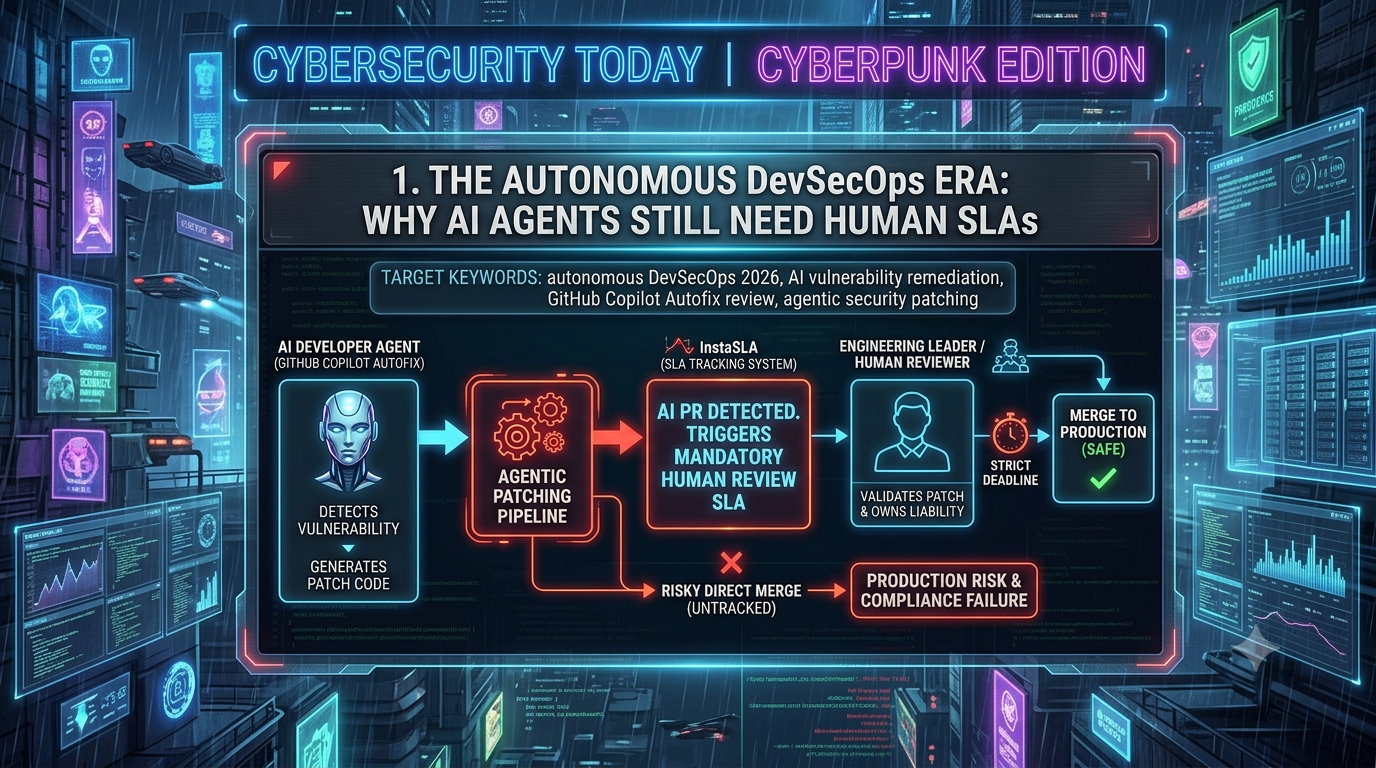
Scan finding -> AI agent -> Fix + validation -> Draft PR -> Human review -> Merge -> RescanThe new bottleneck: PR review paralysis
Speed on the creation side moves the bottleneck to the review side. Consider an illustrative enterprise with 200 repositories that wakes up to 50 automated security PRs. Reviewers who already carry sprint work will triage by instinct, and the PRs that linger are often the ones that matter. Automation that generates fixes faster than people can verify them has not reduced risk. It has relocated the backlog.
Capabilities versus reality
| Dimension | AI remediation agent | Human reviewer |
|---|---|---|
| Time to draft a patch | Minutes (GitHub cites 2 to 4 minutes per fix) | Hours to days, depending on backlog |
| Routine dependency and linting fixes | Strong | Prone to skipped or delayed updates |
| Business logic and authorization rules | Limited visibility into domain intent | Understands intent and constraints |
| Blast radius across services | Often scoped to the files it explores | Can weigh cross-service impact |
| Legal and audit accountability | None | Direct |
Three pieces of evidence explain why the bottom rows matter.
1. AI-generated code still fails security tests at a steady rate. Veracode's 2026 GenAI Code Security Report, covering more than 100 models, found an average security pass rate of 56%, essentially unchanged from 55% in the first report, meaning roughly 44% of code generation tasks introduced a known vulnerability. Over the same period, syntax correctness has climbed above 95%. Two caveats belong in any honest summary. This is a vendor study, and it measures writing new code on security-sensitive tasks, not repairing existing alerts, which is an easier and more constrained job. Treat it as evidence that "compiles and passes tests" is not the same as "secure," not as a failure rate for autofix.
2. Validation by the scanner is not validation by a person. GitHub's own documentation says agentic autofix re-runs CodeQL on a best-effort basis, cannot confirm alerts from custom queries or the security-extended suite through that path, and does not guarantee fix quality for third-party alerts. A closed alert means the detector stopped firing. It does not prove the intent of the code is intact. Take an Insecure Direct Object Reference (IDOR) finding as a hypothetical: an agent could "fix" it by removing the access check that triggered the rule. The scanner goes quiet and the backdoor remains. Only someone who understands the trust boundary catches that.
3. Human reviewers already treat security PRs from agents with extra caution. An empirical study of the AIDev dataset (33,000+ agent-authored PRs, of which 1,293 were confirmed security-related) found that security-related agentic PRs make up about 4% of agent activity, and that they show lower merge rates and longer review latency than non-security agentic PRs. The authors read this as heightened human scrutiny. Notably, most of these PRs were supportive hardening such as tests, documentation, configuration, and error handling rather than narrow vulnerability fixes.
Why auto-merging security patches is high-risk
1. Regulators now attach clocks to vulnerabilities
The EU Cyber Resilience Act's reporting obligations became applicable on September 11, 2026, and ENISA's Single Reporting Platform went live the same day. Manufacturers of products with digital elements must report actively exploited vulnerabilities and severe incidents: an early warning within 24 hours of becoming aware, a fuller notification within 72 hours, and a final report no later than 14 days after a corrective or mitigating measure is available. (The clock runs from awareness, not from discovery in a scanner.)
Two details matter for engineering teams. Commission guidance reportedly expects manufacturers to report exploitation of a vulnerability in a third-party component, unless the vulnerable code is not reachable or not exploited in that product. Making that call in 24 hours depends on knowing what is in your builds. And the obligations apply to products already on the EU market, not only new ones. The broader CRA product requirements apply from December 11, 2027.
Separately, in the US, CISA's Binding Operational Directive 26-04, issued June 10, 2026, replaced flat deadlines for federal civilian agencies with a four-variable risk model (asset exposure, KEV status, exploit automation, technical impact). The most urgent combinations carry a three-calendar-day remediation deadline, sometimes with forensic triage. It binds federal agencies, but it has become a widely referenced benchmark for how fast "critical" is supposed to move.
2. Auditors want authorized, documented change control
SOC 2's change management criterion (CC8.1) asks that changes are authorized, tested, approved, and documented. It does not literally say a human must click "approve," and some practitioners argue that a scoped, evidenced automated-approval policy for low-risk changes can satisfy it. But the control still requires separation of duties, a written policy, and a trail linking every production change to an approval. "The agent merged its own commit" fails all three unless you have deliberately designed for it. Most teams find the simplest way to produce that evidence is a required human approval on the pull request.
3. Hallucinated dependencies turn a fix into an entry point
Package hallucination is measurable. A USENIX Security 2025 study tested 16 code-generating models across 576,000 samples and found average hallucinated-package rates of at least 5.2% for commercial models and 21.7% for open-source models, with more than 205,000 unique fabricated package names. Attackers can register those names on public registries, a technique called slopsquatting. Researchers have documented a hallucinated huggingface-cli package drawing over 30,000 downloads in three months, and a hallucinated react-codeshift package spreading through agent-generated skills across hundreds of repositories. An agent that "fixes" a vulnerable dependency by referencing a package that does not exist, and a pipeline that merges it unreviewed, is the exact failure mode a human check exists to catch.
4. Teams lose their mental model of the system
This one is an argument rather than a measured finding. If engineers stop reading security changes because an agent handles them, their understanding of the system's security posture erodes, and that understanding is what they rely on during a zero-day incident. Regular review of agent output is partly a way of keeping the team's context alive.
The solution: an accountable clock on human review
To keep the velocity without losing control, separate creation from authorization. The agent produces the candidate fix. A named engineer verifies and authorizes it. To keep that verification from becoming an open-ended bottleneck, the review needs a deadline that is calculated automatically and enforced.
This is the governance layer InstaSLA provides:
AI agent opens remediation PR
        |
        v
InstaSLA triggers severity-based review SLA
        |
        +--> Human validates and merges  --> compliant, verified
        |
        +--> SLA nearing breach          --> escalate to tech lead
How the InstaSLA Human-in-the-Loop workflow works
- Event interception. When an agent such as GitHub Copilot, Snyk, or OpenHands opens a remediation PR, InstaSLA picks up the webhook event.
- Ownership routing. It inspects repository metadata, the CODEOWNERS file, and the Pipeline Bill of Materials (PBOM) to identify who owns the affected service.
- Severity-based SLA. It sets a review deadline from CVSS, reachability, and asset criticality. As an example policy:
- Critical (for example, actively exploited or on the CISA KEV list): 4-hour review SLA
- High: 24-hour review SLA
- Medium and low: 72-hour review SLA
- Queue and escalation. The reviewer gets the contextual diff, test results, and a live timer. If the deadline approaches, the item escalates to the engineering lead or a secondary on-call security engineer.
- Audit record. When the reviewer merges, the tool records who reviewed the fix, what tests ran, when approval was granted, and the exact response time.
A note on those numbers: they are example defaults, not an industry standard, so tune them to your own risk appetite. The 4-hour figure is deliberately short because a review SLA is only one segment of the total remediation window. Under a BOD 26-04-style three-day deadline for the riskiest vulnerabilities, review, merge, deploy, and verification all have to fit inside 72 hours, so review cannot be allowed to consume most of it.
A four-phase blueprint for governed auto-remediation
Phase 1: Define bounded auto-remediation policies. Do not give agents unrestricted scope. Start with low-risk, deterministic changes such as non-breaking minor dependency updates, static configuration corrections, and isolated linter-detected issues. Require explicit opt-in for anything touching authentication, session management, or cryptography.
Phase 2: Enforce approval gates in the pipeline. Use branch protection or repository rulesets so that PRs opened by bots and service accounts cannot merge without a required approval from a human who is not the author. Where your compliance regime calls for it, keep the approval evidence in a form auditors can retrieve. Also verify that new dependencies exist and are what you expect, using lockfiles and registry provenance checks, before a human approves.
Phase 3: Attach an SLA to every agentic PR. Integrate InstaSLA with GitHub, GitLab, or Bitbucket so each auto-generated PR receives a deadline the moment it opens, and shows up in one prioritized queue alongside ordinary code reviews.
Phase 4: Measure verified closure, not volume. Stop celebrating "PRs opened by AI." A more useful metric is Verified Closure Rate: the share of AI-generated patches that were reviewed, merged, and independently confirmed fixed by a post-deployment rescan within the SLA window. (This is a proposed metric, not an established standard, but it measures the outcome that matters.)
The path forward: trusted autonomy
Agentic remediation is going to keep improving. Vendors are already adding guardrails such as breaking-change scoring, scanner-based self-verification, and draft-by-default PRs, and those help. But better agents make a governed review step more valuable, not less, because they raise the volume of changes that need an accountable owner.
Speed without governance is accelerated risk. Let agents do the drafting, and let engineers keep the decision, with a clock that makes sure the decision actually gets made.
Questions for engineering leaders
- How many AI-generated or dependency-update PRs are open across your repositories right now, and what is your median time to review them?
- Does your pipeline technically prevent a non-human account from merging to a production branch without an independent human approval?
- When a third-party tool opens a security fix, how do you know whether your SLA was met?
- If a CRA-style 24-hour clock started tomorrow for an exploited dependency, could you tell within hours whether your products are affected?
Sources
- GitHub Changelog, "Agentic autofix for code scanning alerts in public preview" (July 2026): https://github.blog/changelog/2026-07-10-agentic-autofix-for-code-scanning-alerts-in-public-preview/
- GitHub Docs, "About Copilot Autofix for code scanning": https://docs.github.com/en/code-security/concepts/code-scanning/copilot-autofix-for-code-scanning
- GitHub Blog, "Found means fixed: Introducing code scanning autofix": https://github.blog/news-insights/product-news/found-means-fixed-introducing-code-scanning-autofix-powered-by-github-copilot-and-codeql/
- DEV Community, "Can Copilot Fix Its Own Security Findings? Testing GitHub Agentic Autofix": https://dev.to/pwd9000/can-copilot-fix-its-own-security-findings-testing-github-agentic-autofix-351b
- Snyk User Docs, "What's new": https://docs.snyk.io/whats-new
- Snyk Blog, "Remediation Agents and Agentic AppSec Explained": https://snyk.io/blog/remediation-agents-demystified/
- OpenHands Blog, "The OpenHands Vulnerability Fixer": https://www.openhands.dev/blog/20260303-vulnerability-fixer
- Veracode, "2026 GenAI Code Security Report": https://www.veracode.com/blog/2026-genai-code-security-report-ai-risk/
- arXiv 2601.00477, "Security in the Age of AI Teammates: An Empirical Study of Agentic Pull Requests on GitHub": https://arxiv.org/abs/2601.00477
- arXiv 2406.10279, "We Have a Package for You! A Comprehensive Analysis of Package Hallucinations by Code Generating LLMs": https://arxiv.org/pdf/2406.10279
- European Commission, "Cyber Resilience Act: Reporting obligations": https://digital-strategy.ec.europa.eu/en/policies/cra-reporting
- Crowell & Moring, "EU Cyber Resilience Act: September 11, 2026 Reporting Deadline": https://www.crowell.com/en/insights/client-alerts/eu-cyber-resilience-act-countdown-11-september-2026-incidentvulnerability-reporting-deadline-is-less-than-100-days-away
- CISA, "BOD 26-04: Implementation Guidance for Prioritizing Security Updates Based on Risk": https://www.cisa.gov/news-events/directives/bod-26-04-implementation-guidance-prioritizing-security-updates-based-risk
- AuditPath, "SOC 2 Change Management: CC8.1 Requirements Explained": https://www.auditpath.io/blog/soc2-change-management
- heygrc, "SOC 2 never said a human has to approve your pull requests": https://heygrc.com/blog/soc-2-never-said-a-human-approves-your-prs[Designing a Vulnerability Escalation Matrix: What Happens at 75%, 90%, and 100% of Your SLA?](/blog/designing-vulnerability-escalation-matrix-what-happens-75-90-100-sla)