DevSecOps Operations
DevSecOps Tool Sprawl: Why Scanning Tools Need an Execution Layer
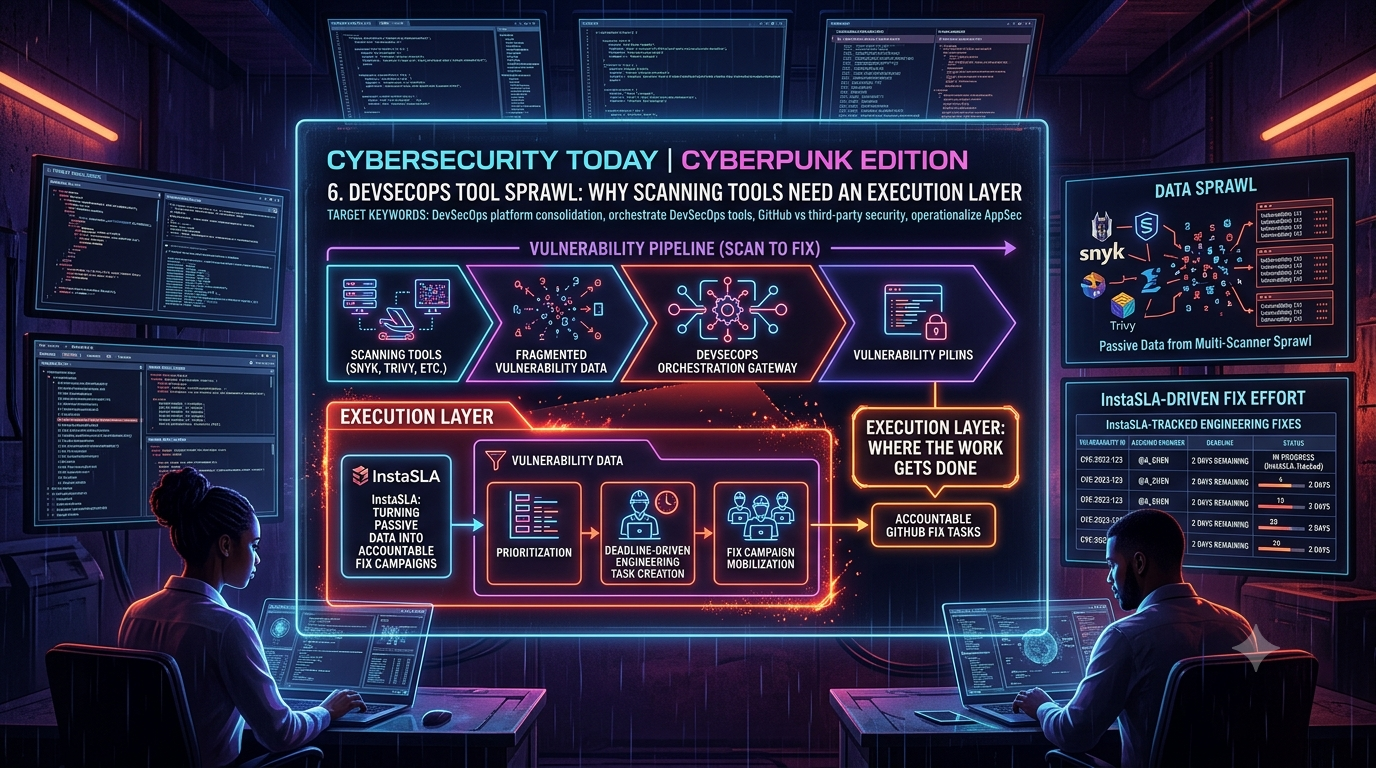
Scanning tools find vulnerabilities but don't fix them. Learn how an execution layer in GitHub orchestrates DevSecOps tools into actionable Fix Campaigns
By InstaSLA Superadmin · Published · 14 min read
DevSecOps Tool Sprawl: Why Scanning Tools Need an Execution Layer
Chief Technology Officers reviewing their 2026 software budgets are running into an uncomfortable pattern: they are paying for security tools that are very good at finding problems and far less involved in getting them fixed. A typical enterprise software supply chain is guarded by a patchwork of scanners. Static Application Security Testing (SAST) covers source code, Dynamic Application Security Testing (DAST) covers running applications, Software Composition Analysis (SCA) covers dependencies, and Cloud-Native Application Protection Platforms (CNAPP) cover infrastructure.
The detection side of that investment works. The remediation side is not keeping up. Veracode's 2026 State of Software Security report, built on 1.6 million applications and 141 million findings, found that 82% of organizations now carry security debt (flaws left open for more than a year) and 60% carry critical security debt, up from 50% a year earlier. Verizon's 2026 Data Breach Investigations Report found that exploiting vulnerabilities is now the most common way into a breach, at 31% of initial access, up from 20% the year before. It is the first time in the report's 19-year history that this has overtaken credential abuse.
Discovering a flaw is not the same as fixing it. The pressure to consolidate DevSecOps platforms is mounting, and not only to cut licensing costs. Security tools are excellent at generating alerts, but without an execution layer to assign ownership, set deadlines and prove closure, those alerts remain passive data points on a dashboard.
The Origin of the Alert Cannon
To understand why an execution layer is necessary, it helps to see how the modern AppSec stack turned into an alert cannon. For the past decade the prevailing philosophy was "shift left": catch vulnerabilities earlier in the development lifecycle, where they are cheaper and safer to fix. Vendors responded with specialized scanners designed to plug into CI/CD pipelines.
Meanwhile, the volume of code has exploded. Big tech is the leading indicator. Microsoft's CEO said in April 2025 that roughly 20–30% of the code in Microsoft's repositories was written by AI. Google's CEO said in October 2024 that more than a quarter of new code at Google was AI-generated, and then said at Google Cloud Next in April 2026 that the figure had reached 75% of new code, AI-generated and approved by engineers, up from 50% the previous autumn. Outside the largest tech companies the numbers are lower and mostly self-reported: developers in Sonar's early-2026 survey estimated that 42% of their code was AI-generated or AI-assisted, up from 6% in 2023, and the 2025 Stack Overflow survey found that 84% of developers use or plan to use AI tools. Treat all of these as directional rather than precise, but the direction is unmistakable.
Dependencies are growing at the same time. Black Duck's 2026 Open Source Security and Risk Analysis (OSSRA) report, based on audits of 947 commercial codebases across 17 industries, found that 98% contain open source components. The mean number of open source vulnerabilities per codebase rose 107% in a single year, the average component count rose 30%, and files per codebase rose 74%. Black Duck points to AI coding assistants as a likely contributor but is careful not to pin the surge on one cause. It also found that 65% of organizations experienced a software supply chain attack in the past year.
Now add five uncoordinated scanners on top of that growth. Each emits findings in its own format, with its own severity logic, into its own console. Findings can arrive faster than people can triage them, spread across Slack, Jira, email and IDE plugins. When tooling produces too many noisy or duplicate alerts, developers lose trust in the output and start treating security gates as obstacles to route around. Raw finding volume stops mapping to actual risk reduction.
Every scanner is also a dependency
Sprawl has a second cost that budgets rarely capture: every scanner, action and plugin in your pipeline is itself part of your supply chain, and it usually runs with access to your secrets.
In March 2026, attackers used credentials that survived an incompletely contained earlier incident to publish a malicious release of Aqua Security's Trivy scanner. They also force-pushed 76 of the 77 version tags in aquasecurity/trivy-action and all seven tags in aquasecurity/setup-trivy to point at credential-stealing code. Any workflow that referenced a version tag picked up the attacker's code without a single change to its own workflow file. Microsoft described the incident as trusted security tooling being turned against the organizations that relied on it.
The lessons are unglamorous. Pin third-party actions to full commit SHAs rather than mutable tags, rotate credentials completely after any incident, and include your scanners in the same inventory of owned, maintained components as everything else. More tools means more surface to defend, which is one more reason the sprawl conversation cannot stop at licensing costs.
The Remediation Gap: Why Scanners Fail to Protect You
Vulnerability remediation is one of the most operationally demanding disciplines in security, yet identification is rarely where programs struggle. The failure point is the gap between the security team's dashboard and the developer's working environment.
Consider a standard enterprise workflow. A scanner such as Trivy or Snyk surfaces a critical CVE in a logging library, and the finding lands in a central security dashboard. Engineering works out of separate ticketing systems with no consistent, automated handoff. Days pass while an analyst translates the CVE into a ticket and works out which engineering manager owns the affected repository. The vulnerability stays open the whole time.
The industry data shows how common that pattern is:
| Metric | Figure | Source |
|---|---|---|
| Organizations carrying security debt (flaws open over a year) | 82%, up from 74% | Veracode, State of Software Security 2026 |
| Organizations carrying critical security debt | 60%, up from 50% | Veracode, 2026 |
| Fix half-life: all flaws / third-party (SCA) flaws | 243 days / 358 days | Veracode, 2026 |
| Vulnerability exploitation as the top initial access vector | 31%, up from 20% | Verizon DBIR 2026 |
| CISA KEV vulnerabilities fully remediated in 2025 | 26%, down from 38% | Verizon DBIR 2026 |
| Median time to remediate those vulnerabilities | 43 days, up from 32 | Verizon DBIR 2026 |
| Vulnerabilities still unpatched after 180 days | Roughly a third (31%, 33% and 32% across the last three reports) | Indusface, State of Application Security |
| Estimated mean time to exploit | About −7 days | Mandiant, M-Trends 2026 |
A few notes on reading this table honestly. Veracode, Black Duck and Indusface are vendors reporting on their own customer or scan populations, so their figures are best read as strong indicators, not census data. The Indusface figure has held near a third for three straight reports, which suggests a structural problem rather than a bad year. And the Mandiant number deserves a caveat of its own: a negative mean time to exploit means that, on average, exploitation begins before a patch exists. Patch SLAs cannot solve that class of problem. Mitigation playbooks, exposure reduction and detection matter for the zero-day tail. But the majority of what fills a backlog is known, patchable and often already exploited (the KEV problem above), and that is exactly where missed deadlines and unclear ownership do the damage.
Prioritization alone does not close the gap. Even when an Application Security Posture Management (ASPM) tool groups and ranks alerts well, it is still a mostly read-only mechanism. It tells the organization what is wrong; it does not orchestrate the work required to fix it. Veracode's own advice is telling here: it argues teams should concentrate on the 11.3% of flaws that pose real-world danger rather than trying to clear everything. That is a call for prioritization and for someone to be accountable for acting on it. Effective programs connect each finding to the specific update, patch or configuration change required, and to a named owner with a date.
GitHub vs Third-Party Security: The Consolidation Debate
Facing sprawl, many CTOs try to mandate consolidation, and the debate usually becomes GitHub versus third-party tools.
One side pushes to retire best-of-breed scanners (Snyk, Checkmarx, Veracode) and move to native platform tooling. The argument is compelling: the tools live where the code lives, which reduces context switching and simplifies procurement. It is also easier to buy than it used to be. Since April 2025, GitHub Advanced Security has been sold as two standalone products, GitHub Secret Protection at $19 and GitHub Code Security at $30 per active committer per month at list price, and both are available on the Team plan, not just Enterprise.
Native tooling has also moved well beyond detection. GitHub Code Security includes security campaigns, which let a security team bundle code scanning alerts, set a fix-by timeframe, and have Copilot Autofix propose fixes and notify the developers closest to the code. In July 2026 GitHub put agentic autofix into public preview for all code scanning alerts, including those from third-party tools: the agent proposes a fix, reruns the original analysis to confirm the alert closes, and opens a draft pull request. (It requires a Copilot license with the cloud agent enabled and draws down AI credits.) So the old claim that native tooling only detects is out of date.
The other side argues that specialized third-party tools offer deeper language-specific analysis, better dynamic testing, or stronger runtime context, and that real prioritization needs reachability: whether a vulnerable component is actually deployed, exposed, or connected to a sensitive path.
Both camps have a point, and the debate still misses the bigger one. You do not necessarily need fewer tools to be efficient; you need the outputs of your tools to land in one place where ownership, deadlines and evidence are handled consistently. A campaign deadline in one product is useful, but it does not by itself give you per-alert ownership history, breach status across hundreds of repositories, escalation when a date slips, or exportable audit evidence, and it does not cover findings that never enter that product. Consolidate to a single vendor without that layer and time-to-remediate will stay poor. Keep five best-of-breed scanners but route their output into one accountable workflow, and the breadth becomes an asset (coverage) rather than a liability (noise).
How to Operationalize AppSec
Operational AppSec means treating security as a system driven by rhythm, responsibility and clarity, not a set of isolated scanning activities. Three traits matter most.
Shared accountability. Security becomes a collective engineering commitment. Developers are the first line of defense, QA validates security alongside functionality, and the security team provides oversight. That spreads responsibility so security does not bottleneck on one team's capacity.
Repeatable workflows. Every finding needs a pre-defined closure path, with no ambiguity about the steps from identification through remediation to verification. Predictability lowers engineering friction and gives leadership real visibility into progress.
Visible progress and metrics. When remediation data is transparent, teams take ownership naturally, and leaders can decide where effort pays off most.
Set clocks that reflect risk, not just severity
A flat "critical in 7 days, high in 30" policy is easy to write and easy to miss. The direction of travel in government policy is toward risk-tiered clocks. In June 2026, CISA issued Binding Operational Directive 26-04, which replaces the flat deadlines of BOD 22-01 with a model that scores each vulnerability on four variables: public exposure, KEV status, exploit automation potential and technical impact. The tiers run from three days, with forensic triage for the highest-risk cases, through 14 and 60 days, with the lowest-risk items deferred to a planned upgrade. The directive binds federal civilian agencies only, but other organizations are free to borrow the structure. An illustrative policy in that spirit might look like this (the mapping below is an example, not CISA's matrix):
| Finding profile | Example clock |
|---|---|
| Known-exploited, internet-facing | 3 days, plus a check for signs of compromise |
| Known-exploited or easily automated, not internet-facing | 14 days |
| High severity, no known exploitation | 30 days |
| Everything else | 60 days or the next planned upgrade |
Know the regulatory clocks too
If you ship software into the EU, there is a hard external deadline as well. Since 11 September 2026, the Cyber Resilience Act's reporting obligations apply: manufacturers must send an early warning within 24 hours of becoming aware of an actively exploited vulnerability, a fuller notification within 72 hours, and a final report within 14 days of a fix or mitigation becoming available, all through ENISA's Single Reporting Platform. The obligation reaches products already on the market, not just new releases, while the Act's main requirements follow from 11 December 2027. You cannot report on a vulnerability you cannot quickly locate and assign, which makes ownership data an operational necessity rather than a nice-to-have.
Where InstaSLA Fits: An Execution Layer for GitHub-Native Teams
This is where InstaSLA enters the architecture. InstaSLA is not another scanner. According to its public documentation, it installs as a GitHub App, syncs the security alerts (Dependabot alerts included) from the repositories you select, and adds the workflow layer around them.
1. One queue with clear owners. Every synced alert can be assigned to a person, a team or a repository owner, using manual assignment or owner mappings, with an audit history of assignment changes. Alerts stop being an unowned feed and become work with an accountable party.
2. Fix Campaigns for duplicate advisories. When a widely used package hits a critical advisory, dozens or hundreds of repositories can carry the same finding. A legacy process generates a ticket per repository. InstaSLA groups the repeated advisory into a single Fix Campaign so engineering managers can see the whole scope and coordinate the patch, while alert-level ownership and evidence are preserved underneath.
3. Severity-based SLAs with visible breach status. You define remediation windows for critical, high, medium and low findings. Queue views show what is overdue, due today and due this week, and each alert carries its due-date history. Whatever tool holds the clock, write the policy first; the tool should implement your risk logic, not invent it.
4. Escalation before a deadline is missed. Email reminders and escalation policies, with delivery logs, move attention to the right people as due dates approach. That is enforcement through accountability: the deadline is explicit, visible, and tied to a named owner.
5. Audit-ready evidence. Exports capture alert state, owner, due date, remediation history, accepted risk and proof of completion, which supports SOC 2 and ISO 27001 reviews and gives leadership real time-to-remediate numbers instead of anecdotes.
6. Programmatic access. Scoped, revocable MCP tokens let other tools and agents query alert queues and SLA summaries.
One scoping point is worth being direct about. InstaSLA works from GitHub security alerts. A finding from another scanner reaches it if that scanner publishes into GitHub's alert system, for example through code scanning's SARIF upload, and the tool is best understood as a layer on top of your scanners, not a replacement for them or for GitHub's own fix tooling.
Gates for new findings, clocks for old ones
Visibility matters, but some organizations also want hard enforcement, and it helps to separate two problems.
New findings can be gated in the pull request using GitHub's own controls. Rulesets can apply code scanning merge protection, which blocks a pull request when a required tool reports an alert at a severity you define, when analysis is still running, or when a required tool is not configured. Rulesets can also enforce the dependency review action, which blocks pull requests that introduce vulnerable dependencies.
Existing debt is different, and the clock, owner and escalation path do most of the work. Some teams go further and build a custom required status check that fails when an overdue critical exists. If you do, design an audited bypass path from the start: a rigid block on a breached SLA would otherwise stop the very pull request that fixes the breached dependency.
Verification closes the loop. Wherever possible, rely on the original scanner to confirm a fix, as GitHub's agentic autofix does when it reruns the analysis before opening a pull request, and keep the confirmation timestamp as part of your remediation record.
What to Do This Quarter
- Inventory your scanners and pipeline actions. Pin third-party actions to commit SHAs and give each tool an owner.
- Write a risk-tiered SLA policy that reflects exposure and known exploitation, not only CVSS.
- Route every alert to an accountable owner. Unowned findings are the ones that reach 180 days.
- Group duplicates into campaigns so a widely used package advisory is one piece of coordinated work, not a hundred tickets.
- Gate new findings at merge, and manage old ones with clocks and escalation.
- Report time-to-remediate and SLA breach rate to leadership, and keep the evidence exportable.
The Bottom Line
The 2026 data points the same way from several directions: more code, more dependencies, faster exploitation, and remediation that is slipping. Buying another scanner does not change those numbers. Owning, scheduling and proving the fix does. Whether you consolidate on a single platform or keep a best-of-breed stack, the organizations that close the gap will be the ones that add an execution layer on top: clear owners, risk-based deadlines, coordinated campaigns, escalation, and evidence. Scanners tell you what is wrong. The execution layer is what gets it fixed.
Sources
- Veracode, 2026 State of Software Security and security debt analysis; compliance edition (fix half-life figures)
- Verizon, 2026 Data Breach Investigations Report, via Help Net Security, Tenable and TechRepublic
- Google Cloud, M-Trends 2026
- Indusface, State of Application Security 2025 and 2026 statistics summary
- Black Duck, 2026 OSSRA report and press release
- Sundar Pichai, Google Cloud Next 2026 remarks and Fortune, October 2024
- Sonar, State of Code Developer Survey 2026
- Trivy compromise: GitHub security advisory and Microsoft Security Blog
- GitHub, Secret Protection and Code Security announcement, security campaigns GA, agentic autofix preview, code scanning merge protection and rulesets overview
- CISA BOD 26-04, via FedTech, Tenable and CISA implementation guidance
- European Commission, Cyber Resilience Act reporting obligations
- InstaSLA, features and help centerCISA BOD 26-04: How to Meet the New 3-Day Remediation SLA in GitHub