DevSecOps Operations
Eliminating the Silo Between Container Security and Dependency Alert Tracking
Stop juggling dashboards. Unify Dependabot vs container scanning alerts into a single unified vulnerability queue with strict container vulnerability SLAs
By InstaSLA Superadmin · Published · 14 min read
Eliminating the Silo Between Container Security and Dependency Alert Tracking
Modern software delivery relies on a fragile balance between rapid development and robust security. As organizations embrace containerized architectures and cloud-native deployments, a significant operational friction has emerged: the silo between application-level dependency tracking and container-level vulnerability scanning. For security engineers and developers alike, navigating this divide is a daily struggle characterized by fragmented dashboards, duplicate effort, and missed remediation targets.
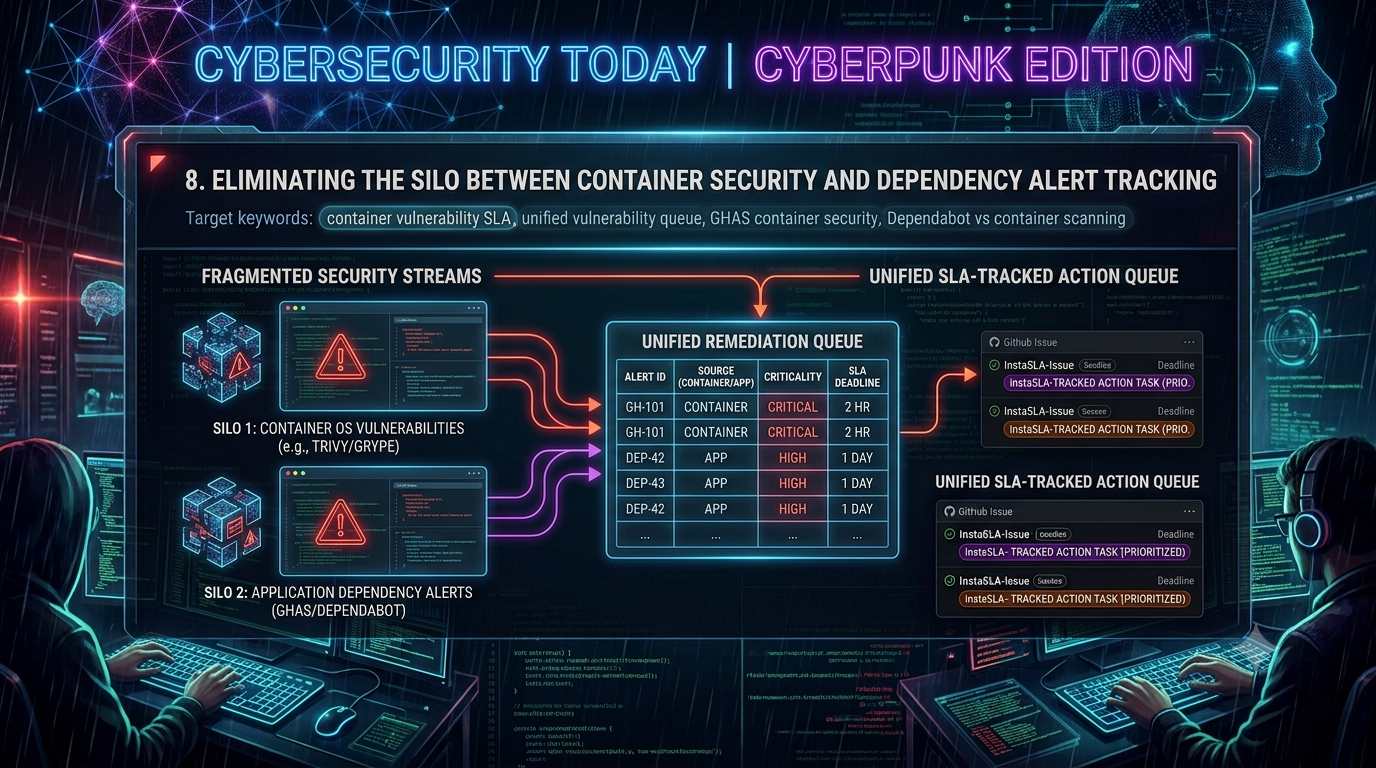
Security teams today juggle findings across cloud, code, and container tools. A developer might track application library alerts in one system while infrastructure engineers monitor base-image vulnerabilities in another. This separation creates a dual-pane nightmare: when a critical vulnerability drops, figuring out whether the risk stems from an outdated npm package or a vulnerable Ubuntu base image — and routing that alert to the right owner — wastes hours that matter. The fix is to abandon isolated workflows in favor of a unified vulnerability queue that enforces a consistent container vulnerability SLA alongside application-level security metrics.
The Fundamental Disconnect: Dependabot vs. Container Scanning
To understand why this silo exists, look at how the tooling evolved. Application security tools were built for developers and wired directly into version control. Infrastructure security tools were built for operations teams and wired into registries and runtime environments. That produced two distinct scanning methodologies: dependency scanning and container scanning — and a common misconception about how much overlap exists between them.
Dependency scanning (Dependabot, Renovate, Snyk Open Source): This analyzes application-level manifests and lockfiles — package.json, requirements.txt, go.sum — to flag vulnerable libraries before they're compiled or packaged, and it typically opens a pull request that bumps the affected package to a patched version. It's worth being precise here: Dependabot does not scan a built Docker or OCI image. Its container-related capability is narrower than many teams assume — it updates the base image tag referenced in a Dockerfile (e.g., bumping FROM node:18 to node:18.20) when GitHub's dependency graph detects a newer, patched tag. It does not open the image itself and inspect what's actually installed inside it. That job belongs to a separate discipline entirely.
Container scanning (Trivy, Grype, Snyk Container): These tools inspect the compiled image layer by layer — the OS packages, system libraries, embedded secrets, and language runtime artifacts that actually ship to production. Where a dependency scanner reads a manifest file, a container scanner unpacks the image itself to see what's really there. This is the distinction the industry sometimes shorthands as "Dependabot vs. container scanning," but the more accurate framing is that they are complementary layers, not competing tools: dependency scanning tells you what your code declares it depends on; container scanning tells you what actually got shipped.
The distinction matters because a clean application manifest doesn't guarantee the runtime image is safe, and a patched base image doesn't mean the application libraries inside it are exposed-free. Teams that treat image scanning as a substitute for build-time software composition analysis (SCA) — or vice versa — routinely miss real issues. A vulnerable Python library is typically remediated by changing a source dependency; a vulnerable OS package usually requires a base-image rebuild. Managing these two distinct remediation paths across disconnected dashboards is where alert fatigue and duplicated effort start.
Trivy vs. Grype: Two Different Answers to "What's in This Image?"
Since container scanning is the half of this equation most teams under-invest in, it's worth understanding the two most widely used open-source tools, because they don't behave identically.
- Trivy (Aqua Security) is the broad, all-in-one option: a single binary that scans container images, filesystems, git repositories, Kubernetes manifests, Helm charts, and Infrastructure-as-Code (Terraform, CloudFormation), and can also generate SBOMs in SPDX and CycloneDX formats. It ships its own offline vulnerability database, refreshed daily, so scans don't depend on hitting external APIs.
- Grype (Anchore) is narrower by design: a focused vulnerability matcher for container images, filesystems, and SBOMs, usually paired with Anchore's companion tool Syft to generate the SBOM that Grype then scans. Independent benchmarks in 2026 consistently find Grype runs roughly 30–40% faster than Trivy on image-only vulnerability scans, and its risk scoring is a genuine differentiator: each finding gets a composite score that blends CVSS severity with EPSS exploit-probability data and CISA KEV status, rather than raw severity alone.
Because Trivy and Grype pull from independently maintained vulnerability feeds and use different matching logic, they don't always report identical findings on the same image — running both and reconciling the results widens real CVE coverage, at the cost of yet another dashboard to reconcile manually. That reconciliation problem is a smaller-scale preview of the exact silo this article is about, and it's a strong argument for feeding both scanners' output into one deduplicating queue rather than choosing one tool and hoping it's authoritative.
The True Cost of Fragmented Dashboards
When vulnerabilities are tracked in silos, several systemic failures compound inside the engineering pipeline.
1. The Context-Switching Penalty
Developers split their attention between a GitHub repository's Dependabot alerts for npm packages and a separate console — a Trivy UI, a registry's built-in scanner, or a cloud provider's security dashboard — for container policy violations. This context switching disrupts flow, and infrastructure alerts that live one click further away tend to get triaged later than code-level alerts sitting in the developer's normal workflow.
2. Misaligned CVSS Prioritization
Every modern scanner generates alerts by CVSS score and calls that "prioritization," but a generic severity score ignores exploitability and environment entirely. A CVSS score reflects theoretical severity in a vacuum — it says nothing about whether anyone is actually exploiting the flaw. This is why security-conscious teams increasingly layer in two other data points before deciding what to fix first:
- EPSS (Exploit Prediction Scoring System) — an open, machine-learning model maintained by FIRST.org that estimates the probability a given CVE will be exploited in the wild within the next 30 days, expressed as a score from 0 to 1 and updated daily. The current version, EPSS v4 (released March 2025), also scores CVEs still sitting in the NVD analysis backlog that don't yet have an official CVSS score.
- CISA's Known Exploited Vulnerabilities (KEV) catalog — a public list of CVEs CISA has confirmed are being actively exploited, based on evidence such as incident response findings and threat intelligence. A CVE is only added once active exploitation is verified and remediation guidance exists, which makes KEV a lagging but high-confidence signal, versus EPSS's predictive-but-probabilistic one. The two are meant to be used together, not as substitutes for each other.
A fragmented system might flag a "critical" CVSS score on an isolated, sandboxed dev container while quietly ignoring a "medium" score on an internet-facing production library that's already on the KEV list. Without a unified view carrying EPSS and KEV context alongside CVSS, developers waste cycles patching theoretical risk while exploitable attack paths sit open.
Note also that the industry is mid-transition on CVSS itself: CVSS v4.0, published by FIRST in November 2023, replaced the old Temporal metric group with a Threat group and added separate impact metrics for the vulnerable system versus downstream ("subsequent") systems — a more granular model than v3.1's single blended score. As of 2026, NVD publishes both v3.1 and v4.0 scores for new CVEs, but most organizations are running v3.1 as their operating baseline while phasing in v4.0, since re-scoring years of historical findings under a new model isn't worth the disruption yet. A unified queue needs to be able to ingest both.
3. Missing the Root Cause (The Deduplication Problem)
Perhaps the costliest failure of fragmented dashboards is the inability to group findings by root cause. If an organization runs an outdated Alpine base image across 50 microservices, a standalone container scanner generates 50 separate alerts. A developer who patches their own service leaves the underlying issue live in the other 49. Without a system that collapses these into one unit of work — "update the golden base image" — the team ends up duplicating remediation effort 50 times over.
This is not a hypothetical inefficiency. Standard, unmodified base images on Docker Hub commonly ship with 50–60 known vulnerabilities out of the box, with roughly 15–20 of those rated high or critical, according to 2025 platform data from container-hardening vendor Minimus — and that vulnerability count exists before a single line of application code is added. Multiply that across dozens of services built on the same stale base image, and the deduplication gap becomes the single biggest lever available for cutting backlog size.
GHAS, Trivy, and the Push for Consolidation
Recognizing the pain of fragmented queues, the industry has been moving toward consolidation, and GitHub Advanced Security (GHAS) is a useful example of both the progress and the limits of that approach.
GHAS bundles CodeQL-based code scanning, secret scanning with push protection, and Dependabot's dependency alerts and pull requests, and by 2026 it added features aimed directly at backlog fatigue: Copilot Autofix, which generates a suggested code-level fix alongside a code-scanning alert; security campaigns, which let a team group related findings into a tracked, time-boxed burn-down effort; and custom auto-triage rules, which let teams automate which Dependabot alerts get snoozed, ignored, or turned into an update PR at scale. Crucially, GHAS also supports centralizing third-party scanner output — including Trivy's — by uploading results in SARIF format, so container-image findings from Trivy can surface in the same interface as Dependabot and CodeQL alerts.
But that SARIF-based aggregation is the ceiling of what "piping Trivy into GitHub" actually buys you. It moves alerts into one screen; it doesn't deduplicate a base-image CVE across 50 repositories, and it doesn't rank a finding by whether it's reachable, deployed, or KEV-listed. If you dump 500 container alerts next to 500 dependency alerts without structural prioritization, you've moved the noise from two dashboards into one. Aggregation is a prerequisite for a unified queue — it is not the queue itself.
Building a Unified Vulnerability Queue (a.k.a. ASPM)
What this article calls a "unified vulnerability queue" already has an established name in the industry: Application Security Posture Management (ASPM), a category Gartner formalized in 2023 specifically to describe an orchestration layer that sits above individual scanners — SAST, DAST, SCA, IaC, secrets, and container tools — and turns their combined output into one prioritized, deduplicated backlog. Gartner has projected that roughly 40% of organizations building proprietary applications will have deployed some form of ASPM framework by 2026, and dedicated ASPM vendors (OX Security, Invicti ASPM, Faraday, Jit, and others) now compete specifically on how well they execute the three pillars below.
1. Comprehensive Ingestion
The first step is a single data layer that ingests findings from every tool — CI/CD pipeline scans, Dependabot alerts, and container scans from Trivy or Grype. The goal isn't to replace existing scanners; it's to sit on top of them and make their combined output usable. Streaming every finding into one centralized graph gives the security team a genuinely unified view of the attack surface, rather than a unified view of whichever tool happened to be checked most recently.
2. Intelligent Deduplication and Grouping
Once data is centralized, the system needs to collapse shared root causes. Instead of 100 individual alerts for the same OpenSSL CVE across different containers, the queue should present one task: "update base image node:18-alpine to node:18.20-alpine." When the platform team ships that update, the system closes the related downstream findings automatically. This "fix once, close many" pattern is exactly why minimal and distroless base images have become a standard recommendation alongside a unified queue, not a competing strategy: a distroless image strips out the shell, package manager, and unused OS libraries where most CVEs live in the first place, so there's simply less for any scanner to flag per service going forward. Vendors offering managed, continuously rebuilt minimal base images (Chainguard's Wolfi-based images, Google's distroless project, Wiz's WizOS) report driving typical vulnerability counts from the hundreds down to near zero per image — which shrinks the deduplication problem at the source rather than only managing it downstream.
Real-world deduplication numbers back this up: ASPM vendors report reducing raw findings volume dramatically through cross-tool correlation — Invicti's ASPM product, for example, cites up to 90% noise reduction from contextual runtime deduplication and up to 95% deduplication across combined code-and-cloud findings.
3. Context-Aware Prioritization
With alerts grouped, they need ranking by real-world exploitability rather than raw CVSS. A unified queue should factor in:
- Deployment status — is this image actually running in production, or just sitting in a registry?
- Network exposure — is the affected asset internet-facing?
- CISA KEV membership — is this CVE confirmed as actively exploited?
- EPSS score — what's the modeled 30-day exploitation probability?
- Reachability — is the vulnerable code path actually invoked by the application, or present-but-dead code?
By combining dependency data (what the app runs) with container data (where the app runs) and threat-intelligence overlays (EPSS, KEV), the queue gives engineers the context to prioritize their day instead of just their inbox.
Enforcing a Container Vulnerability SLA
A unified queue provides visibility, but without enforcement it's a suggestion. To keep technical debt from spiraling, organizations need a formal container vulnerability SLA that sits alongside application security SLAs — a contract dictating how quickly a vulnerability must be remediated based on severity and context.
A commonly cited unified SLA framework, drawn from current practitioner guidance and used by vendors like Wiz for their own base-image commitments, looks like this:
- Critical (actively exploited / public-facing): 24–72 hours
- High (significant CVSS or EPSS / internal network): 14–30 days
- Medium: 60 days
- Low: 90 days or formally accepted as technical debt
It's worth being honest about the gap between that policy and what actually happens: Edgescan's 2026 State of Vulnerability Management report puts the average real-world time to remediate high and critical application vulnerabilities at roughly 55 days, and other 2026 industry analyses put typical critical-vulnerability patch times anywhere from 60 to 150 days across surveyed organizations — even though attackers have been observed exploiting newly disclosed critical flaws in as little as five days after public disclosure. Cyber insurers and compliance frameworks (NIS2, ISO 27001 Annex A 8.8) increasingly ask not just for an SLA policy document but for evidence it's actually being met, often expecting internet-facing criticals patched within 7–15 days. The honest starting point for any organization introducing this kind of SLA is to first measure current, unmanaged remediation time as a baseline, then set a staged target — 30 days, then 15, then the 24–72 hour goal for exposed criticals — rather than mandating a number the current process has no chance of hitting.
To enforce this SLA seamlessly, the unified queue needs to be integrated into the CI/CD pipeline itself.
Automated Routing to Owners
When a container or dependency scanner detects an issue, the unified system should route it automatically to the right owner in their tool of choice — Jira, Slack, or GitHub Issues — with the CVE, its EPSS score, its KEV status, and whether the fix requires a package.json change or a Dockerfile rebuild attached directly to the ticket, so the engineer isn't left digging for context.
Pipeline Blockages (Merge Gates)
The most effective enforcement mechanism ties the SLA to the deployment pipeline directly: if a repository has an overdue critical alert — whether a vulnerable Python library flagged by Dependabot or a vulnerable OS package flagged by Trivy — the CI/CD pipeline fails the build, and the developer can't merge new feature code until the security debt is cleared. GitHub's security campaigns feature is one concrete implementation of this pattern inside GHAS: it lets a team group a specific class of overdue findings into a tracked burn-down effort with its own progress metrics, rather than leaving them scattered across individual repository alert tabs.
Because the queue is unified, developers aren't caught off guard by a hidden infrastructure alert blocking their feature release. They have full visibility into both application and container health inside a single, prioritized dashboard — the entire point of tearing the silo down in the first place.
Conclusion
The line between application code and the infrastructure that runs it keeps getting thinner. As organizations lean further into complex software supply chains and ephemeral Kubernetes deployments, treating dependency scanning and container scanning as separate disciplines is a strategic liability rather than a neutral organizational choice.
Eliminating the silo between code-level alerts and base-image vulnerabilities — through the kind of orchestration layer the industry now calls ASPM — enables intelligent deduplication, context-aware prioritization using EPSS and KEV data, minimal base images that shrink the problem at the source, and a container vulnerability SLA the organization can actually measure itself against. Done well, this unified approach lets developers write secure code and ship secure infrastructure without the friction of context switching, so security operates at the actual speed of modern software delivery rather than the speed of its slowest dashboard.