DevSecOps Operations
Implementing the Security Error Budget for Engineering Squads
Use SRE for AppSec. Learn how tracking InstaSLA breaches creates a Security Error Budget to halt feature work and pay down security debt automatically
By InstaSLA Superadmin · Published · 14 min read
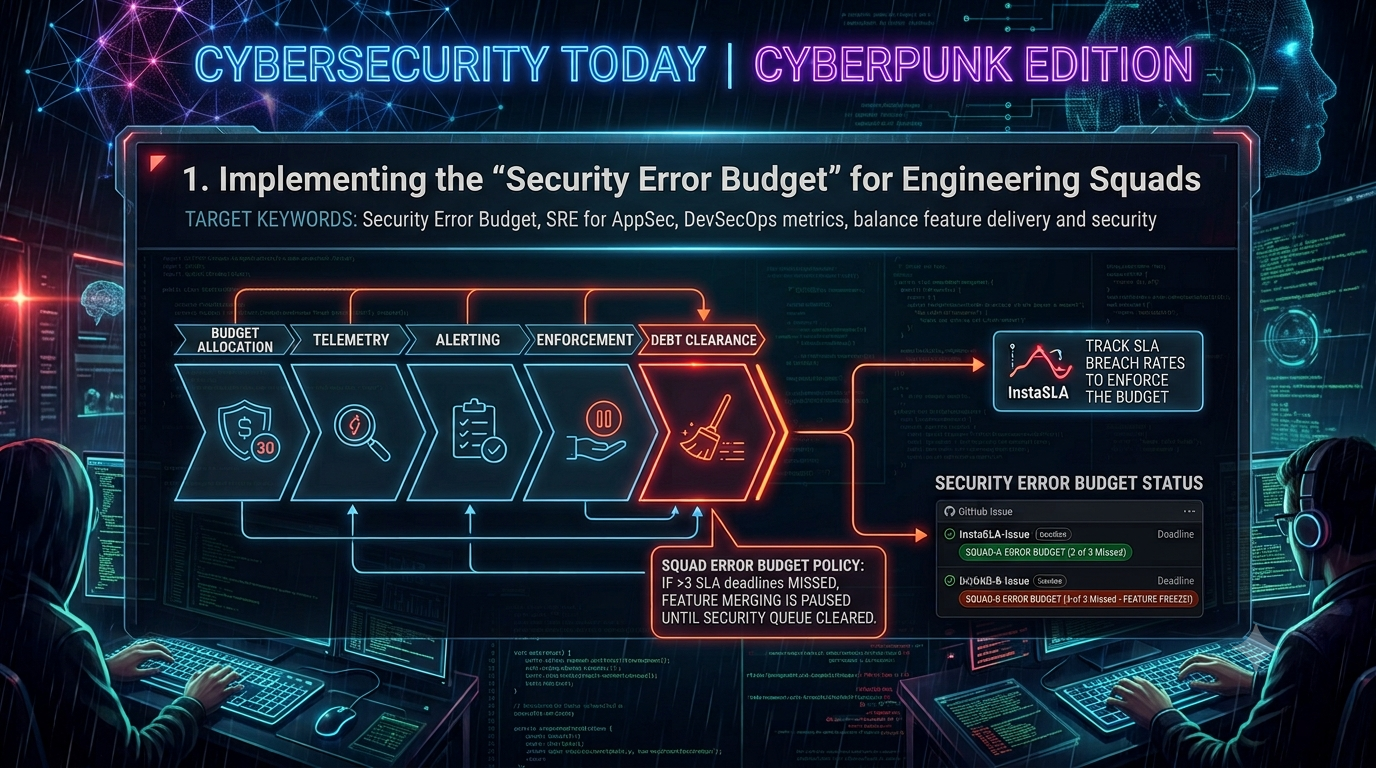
Implementing the Security Error Budget for Engineering Squads
In the modern software factory, the tension between velocity and security is the defining challenge for technology leadership. VPs of Engineering are incentivized to ship features faster, a mandate supercharged by the ubiquitous adoption of AI coding assistants. That adoption is no longer a trend to watch — it's the baseline: Google's 2025 DORA State of AI-assisted Software Development report surveyed nearly 5,000 technology professionals and found 90% now use AI at work, up 14 points year-over-year, with more than 80% saying it has increased their productivity.
But the same report surfaces the cost of that speed. Despite near-universal adoption, 30% of developers report little to no trust in the code AI generates — and the skepticism is earned. Veracode's Spring 2026 GenAI Code Security update, which has been benchmarking frontier models since 2023, found that only 55% of AI coding tasks produce secure code — meaning 45% introduce a known vulnerability, a pass rate that has barely moved across two years of testing despite the same models getting dramatically better at producing code that simply compiles. Java is the weak spot: models passed only 29% of Veracode's Java security tasks in the same round.
Apiiro's research puts a sharper point on it. Looking at millions of lines of code across enterprise repositories, Apiiro found AI-assisted developers write three to four times more code than their peers — but that code generates ten times more security findings, with privilege-escalation paths up 322% and architectural design flaws up 153%, even as syntax errors and logic bugs both fell sharply. By June 2025, AI-generated code was producing over 10,000 new security findings a month, a tenfold jump from six months earlier. As Apiiro's researchers put it, "AI is fixing the typos but creating the timebombs."
Attackers have noticed. Verizon's 2026 Data Breach Investigations Report, its largest dataset in 19 years, found that vulnerability exploitation overtook credential abuse as the single most common way attackers get into a network for the first time — jumping from 20% to 31% of breaches year-over-year, a 55% relative increase, while credential abuse fell to 13%. Median time-to-patch got worse, not better, rising from 32 days in 2024 to 43 days in 2025, and organizations fully remediated only 26% of vulnerabilities on CISA's Known Exploited Vulnerabilities list, down from 38% the year before.
As development speeds increase, traditional security models break down. Security operations teams cannot manually gate every release, and engineering squads frequently ignore static security alerts in favor of meeting sprint deadlines. To resolve this gridlock, engineering and security leaders must look to the discipline of Site Reliability Engineering (SRE). By adapting standard SRE frameworks to application security, organizations can implement a Security Error Budget — a quantitative, unemotional mechanism to automatically balance feature delivery and security.
This article explores how to implement SRE for AppSec, utilizing automated tracking tools like InstaSLA to enforce a definitive rule: If your squad misses more than 3 SLA deadlines, feature merging is paused until the security queue is cleared.
The Velocity vs. Vulnerability Paradox
Historically, the decision to pause feature development to address technical debt or security vulnerabilities has been highly subjective. A security lead might raise a red flag about an accumulating backlog of high-severity vulnerabilities, while a product manager argues that delaying the upcoming release will cost the company critical market share.
In these subjective debates, feature delivery almost always wins. Security debt is kicked down the road until a major breach occurs, at which point the entire organization grinds to a halt for a reactive, panicked "Fix Campaign."
This isn't a hypothetical failure mode — it's measurable, and it's getting worse. Veracode's 2026 State of Software Security report found that 82% of organizations now carry "security debt" — vulnerabilities left unresolved for more than a year — an 11-point jump in a single year, with high-risk vulnerabilities (both severe and highly exploitable) up 36% year-over-year. The average finding, across every scan type, now takes 243 days to close; for third-party and open-source dependencies specifically, which account for two-thirds of all critical security debt, that stretches to 358 days. The subjective, negotiation-driven cycle the industry has run on for years is losing, in plain numbers.
This cycle is unsustainable. To break it, VPs of Engineering and SRE leads need a framework that removes the emotion and negotiation from the process. They need a system based on agreed-upon mathematical thresholds that trigger automatic operational shifts. This is the core philosophy of Site Reliability Engineering, applied to vulnerability management.
What is a Security Error Budget?
In traditional SRE, an "Error Budget" represents the maximum allowable threshold for errors and outages. For example, if a service has a Service Level Objective (SLO) of 99.9% uptime, the error budget is the remaining 0.1% (roughly 43 minutes of downtime per month). While the service is within this budget, developers are free to push new code. Once the budget is exhausted, all feature deployments freeze, and the team must focus entirely on reliability until the budget recovers.
A Security Error Budget takes this exact mathematical concept and applies it to vulnerability remediation. Instead of tracking minutes of downtime, it tracks the accumulation of unpatched, SLA-breaching security vulnerabilities.
The formula for a basic reliability error budget is inherently simple:
$$ \text{Error Budget} = 1 - \text{SLO} $$
For a Security Error Budget, the metric shifts from availability to compliance. The "budget" is defined as the acceptable threshold of risk the business is willing to tolerate at any given moment. This is typically measured not by the total number of vulnerabilities (which can be infinite in a large codebase), but by the team's adherence to remediation SLAs (Service Level Agreements).
It's worth noting this isn't a foreign concept being grafted onto SRE from the outside — it's already baked in. Google's own published SRE Workbook error-budget policy states that when a service exceeds its error budget, all changes and releases are halted except P0/P1 issues or security fixes. Even inside a reliability-only framework, security work already gets treated as urgent enough to bypass the freeze. A dedicated Security Error Budget just formalizes that priority into its own accounting, instead of leaving it as a footnote inside the availability one.
Defining the Security SLA
Before you can budget for errors, you must define the rules of engagement. A modern security SLA dictates strict remediation timelines based on the severity of a finding and the business context of the application. For instance:
- Critical Severity: 24 hours to remediate.
- High Severity: 7 days to remediate.
- Medium Severity: 30 days to remediate.
When a vulnerability crosses its designated time threshold without a fix or an approved exception, it becomes a "breach." The Security Error Budget is determined by the number of allowable SLA breaches a squad can carry before their operational state is forcibly changed.
Timelines this tight aren't arbitrary. Many AppSec programs ran for years on a much looser 14/30/60/90-day baseline by severity. That window has been compressed hard from two directions: regulation (CISA's BOD 26-04 now sets a hard remediation clock for known-exploited vulnerabilities in federal environments) and attacker speed. Research firm Mondoo found that the median time from public disclosure to active exploitation has collapsed from 63 days to just 5 in 2026. A 24-hour critical SLA isn't aggressive for its own sake — it's a response to a defense window that's already almost gone by the time most tickets get triaged.
SRE for AppSec: Shifting the Paradigm
Adopting SRE for AppSec fundamentally changes the relationship between developers and security teams. Security ceases to be a department that simply opens Jira tickets and nags engineers. Instead, security becomes a standard non-functional requirement, measured and enforced via the same pipeline telemetry that tracks performance, latency, and uptime.
The industry is already reaching for language to describe this shift. A April 2026 DZone analysis uses the term "breach budget" for exactly this pattern: applying error-budget discipline not to downtime, but to security risk exposure — thresholds for unresolved critical vulnerabilities, mean time to detect an intrusion, or the percentage of infrastructure failing a security policy check. Whatever it's called, the mechanism is the same one this article is describing: exceeding the budget triggers automatic, non-negotiable remediation focus, exactly as exhausting a reliability error budget halts feature work.
By treating a critical vulnerability SLA breach with the exact same severity as a production service going down, you align the incentives of the engineering team. VPs of Engineering no longer have to arbitrate disputes between product managers and security analysts; the data dictates the action. The system becomes entirely self-governing.
To achieve this state of automated governance, you must establish the correct DevSecOps metrics.
Defining the Right DevSecOps Metrics
To effectively enforce a Security Error Budget, you cannot rely on vanity metrics like "total scans completed" or "lines of code analyzed." You need actionable, outcome-driven DevSecOps metrics that accurately reflect a squad's security posture.
The three primary metrics required for this framework are:
- SLA Adherence Rate: The percentage of security findings remediated within their defined timeframe (e.g., "Squad A resolved 95% of High-severity bugs within 7 days").
- Mean Time to Remediate (MTTR): The average time it takes a squad to fix a vulnerability once it is introduced.
- Active SLA Breaches: The raw count of vulnerabilities that have passed their deadline and remain unresolved in the codebase.
The third metric — Active SLA Breaches — is the foundational trigger for the Security Error Budget. It is unambiguous, easy to calculate, and directly correlates to active organizational risk.
It's also the only one of the three that can realistically scale. OX Security's 2026 Application Security Benchmark found that the average organization now generates 865,398 security alerts, up 52% year-over-year. No squad lead is triaging that volume by hand, which is exactly why a single, automatically-tracked breach count — not a dashboard of raw scan output — has to be the trigger a CI/CD gate checks against.
InstaSLA: The Telemetry Engine for Security SLA Breaches
Calculating Active SLA Breaches across a large enterprise with thousands of microservices and millions of lines of code is impossible if you are relying on manual Jira queries or disconnected security scanning dashboards. You need a dedicated telemetry engine that bridges the gap between vulnerability discovery and engineering workflow.
This is where a platform like InstaSLA becomes critical. InstaSLA acts as the centralized nervous system for your vulnerability management framework. It ingests data from your various security tools (SAST, DAST, SCA, Container Security), maps the vulnerabilities to specific code owners or engineering squads, and begins tracking the clock against your predefined SLAs.
InstaSLA provides the exact telemetry needed to run a Security Error Budget:
- Real-time Queue Visibility: Squad leads can see exactly what vulnerabilities are approaching their SLA deadline.
- Deduplication and Grouping: It groups duplicate alerts (e.g., a vulnerable Log4j library used in 20 places) into a single actionable campaign, ensuring the breach count is fair and accurate.
- Context-Aware Severity: Raw severity labels alone are a noisy filter for what should count against a budget — Datadog's 2026 research found that only about 18% of findings flagged "critical" remain critical once actual runtime reachability is factored in. A telemetry engine worth trusting needs to weigh exploitability and reachability, not just a CVSS score, before it starts a clock.
- Automated Alerting: It proactively warns squads before a breach occurs, giving them the opportunity to shift priorities.
- The "Breach State" API: Most importantly, InstaSLA exposes a programmatic state indicating whether a squad is currently operating within their budget or if they have exhausted it.
The Golden Rule: Automating the Feature Pause
With the SLAs defined, the metrics chosen, and the telemetry engine (InstaSLA) in place, the VP of Engineering can implement the core mechanism of the Security Error Budget.
The policy must be transparent, universally applied, and non-negotiable: "If an engineering squad carries more than 3 active SLA breaches, their Security Error Budget is exhausted. All feature merging to the main branch is paused until the security queue is cleared."
Why 3 breaches? The exact number can be adjusted based on organizational maturity (e.g., a highly mature DevSecOps team might have a zero-tolerance policy, setting the budget at 0 breaches). However, allowing a small buffer of 3 breaches acknowledges the reality of software development — sometimes a complex refactor takes a day longer than the SLA allows, or a third-party vendor delays a patch. It provides a small amount of friction-absorbing padding without allowing massive debt accumulation.
Implementing the CI/CD Pipeline Gate
A policy is only effective if it is enforced. To prevent the Security Error Budget from becoming an empty threat, the feature pause must be automated directly within the CI/CD pipeline.
This requires configuring your source control system (e.g., GitHub, GitLab) and your CI/CD runner to query InstaSLA during the pull request (PR) process.
The Workflow:
- A developer on Squad A attempts to open a Pull Request for a new product feature.
- The CI pipeline initiates its standard checks (unit tests, linting, build).
- The pipeline makes an API call to InstaSLA:
GET /squads/squad-a/sla-status. - InstaSLA responds with the current metric: Squad A currently has 4 active SLA breaches (High severity vulnerabilities older than 7 days).
- Because the count (4) exceeds the Security Error Budget (3), the CI pipeline automatically fails the policy check.
- The PR is blocked from merging. An automated comment is posted on the PR: "Merge blocked: Security Error Budget Exceeded. Squad A currently has 4 active SLA breaches. Please resolve these security findings in InstaSLA before merging new features."
This automation completely removes the human element of enforcement. The security team doesn't have to act as the "bad guy" blocking a release, and the engineering manager doesn't have to manually halt work. The pipeline simply enforces the mathematical reality of the budget.
The Cultural Shift: Aligning Incentives
Implementing a rigid Security Error Budget often faces initial resistance. Developers may feel they are being unfairly punished for legacy code issues or noisy scanners. However, once the initial friction subsides, the cultural shift is profoundly positive.
1. Empathy for the "Fix": When feature delivery is blocked by security debt, fixing vulnerabilities suddenly becomes the highest priority for the entire squad, not just a side-task for the junior engineer. Senior engineers step in to architect robust fixes because their feature work is contingent upon a clean queue.
2. Improved Scanner Tuning: If noisy false positives are consuming the error budget and blocking features, engineering squads will proactively work with the security team to tune the scanners and improve accuracy. Security ceases to be a black box; developers become invested in the quality of the security telemetry.
3. Proactive Prioritization: Squad leads gain total control over their destiny. Because tools like InstaSLA provide visibility into the impending SLA deadlines, a good engineering manager will naturally incorporate security fixes into the sprint before they breach the SLA. The threat of the automated pause drives proactive backlog management.
To effectively balance feature delivery and security, security must become a prerequisite for delivery. The Error Budget enforces this reality.
Real-World Example: A Squad Hitting the Limit
Consider the "Checkout Cart" squad at a mid-sized e-commerce company. The squad is utilizing AI coding assistants to rapidly rewrite their microservices in Go. The AI introduces several flawed dependency imports, triggering 5 High-severity alerts in their SCA tool.
Day 1: InstaSLA ingests the alerts and starts the 7-day SLA countdown. The squad is notified but ignores the alerts to focus on launching a new payment gateway. Day 6: InstaSLA sends a warning to the squad lead: "Warning: 5 High-severity vulnerabilities will breach SLA in 24 hours. Security Error Budget limit is 3." The squad lead decides to push through the feature work anyway. Day 8: The SLAs breach. The squad now has 5 active breaches. Their error budget (3) is exhausted. Day 9: A developer attempts to merge the new payment gateway code. The CI/CD pipeline queries InstaSLA, sees the 5 breaches, and blocks the merge. The PR turns red. Day 9 (Afternoon): The VP of Engineering does not need to intervene. The squad lead recognizes the state. They pause feature work and assign the team to update the vulnerable dependencies. Day 10: The fixes are committed. InstaSLA verifies the vulnerabilities are gone and clears the breaches. The squad's active breach count drops to 0. The CI/CD pipeline immediately turns green, and the payment gateway feature is merged.
In this scenario, a critical risk was remediated rapidly without emotional debates, meetings, or executive escalation. The system worked exactly as designed.
Conclusion: The Future of Governed Velocity
As AI continues to lower the barrier to generating code, the volume of software created by engineering teams will grow exponentially, and the data above shows the remediation side of that equation is already losing ground: fewer than a third of known-exploited vulnerabilities got fully patched in 2025, patch times are getting slower rather than faster, and attackers are exploiting disclosed flaws in days instead of months. Attempting to manage the resulting security debt through manual ticketing and subjective negotiation is a failing strategy, and the numbers say it's failing right now, not just in theory.
VPs of Engineering and SRE leads must collaborate to establish automated, data-driven governance. By implementing a Security Error Budget, defining strict DevSecOps metrics, and utilizing a telemetry platform like InstaSLA to block CI/CD pipelines when SLAs are breached, organizations can create a sustainable development culture. SRE for AppSec guarantees that teams can move as fast as possible, but never faster than they can secure.Applying SRE Principles to AppSec: Introducing the "Security Error Budget"