DevSecOps Operations
Security Error Budgets: Balancing DORA Metrics with Vulnerability SLAs
Balance deployment velocity with security SLAs. Learn how SREs use InstaSLA telemetry to set Security Error Budgets and burn down critical tech debt
By InstaSLA Superadmin · Published · 11 min read
Security Error Budgets: Balancing DORA Metrics with Vulnerability SLAs
In the high-stakes environment of modern software delivery, Site Reliability Engineers (SREs) and DevOps leaders operate under a dual mandate: ship code faster and keep the systems stable. For years, the industry has relied on standardized benchmarks to measure success in these areas. However, as the cyber threat landscape has evolved and the pace of development has accelerated, a critical tension has emerged between velocity and vulnerability. High-performing engineering teams deploy code multiple times a day, but this rapid DevSecOps deployment frequency often obscures a growing, silent threat: the accumulation of unpatched vulnerabilities and compounding security debt.
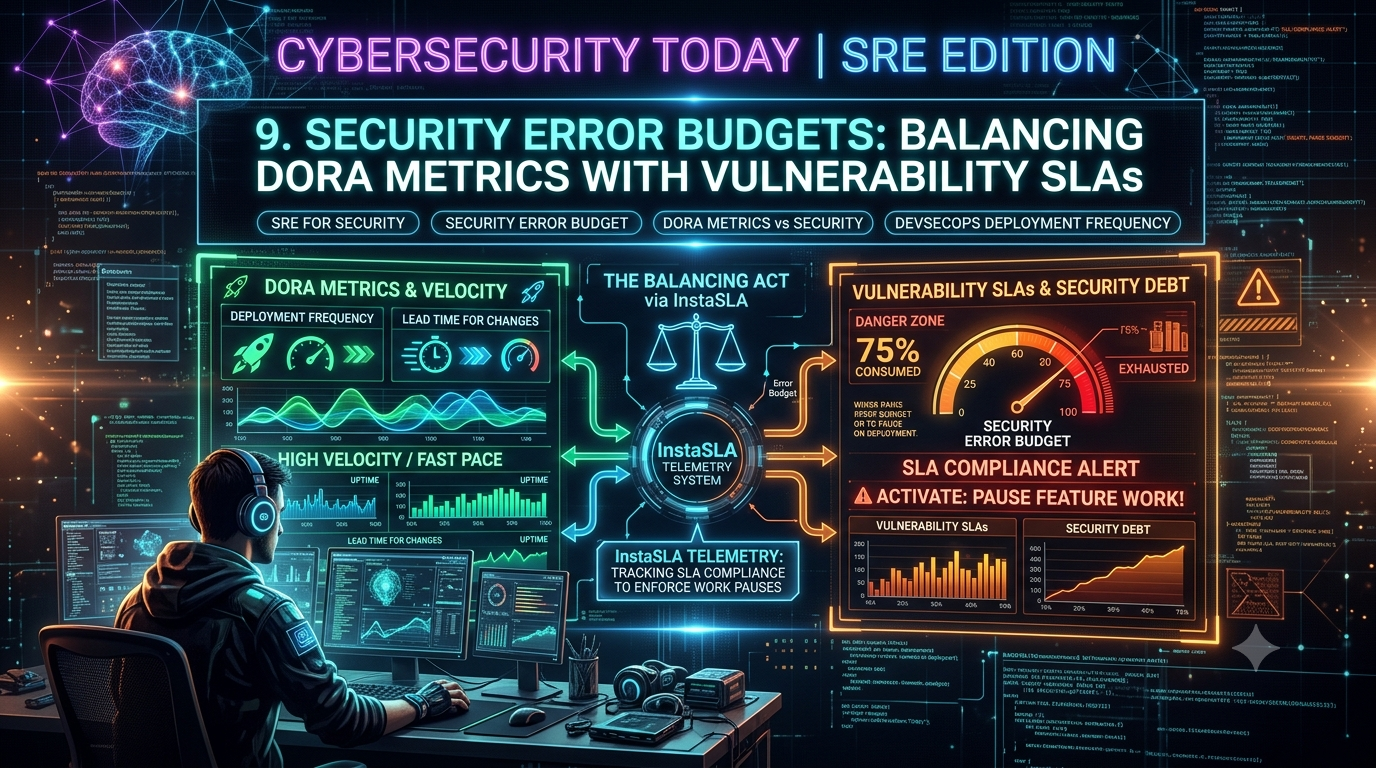
To resolve this conflict, organizations cannot simply tell developers to "code more securely" or rely on outdated manual gates. Instead, they must mathematically manage the tension. This article explores the intersection of SRE for security and rapid release cycles. By introducing the concept of a "Security Error Budget"—and utilizing SLA telemetry platforms like InstaSLA to enforce it—teams can finally bridge the gap in DORA metrics vs. security. The result is a pipeline where teams can deploy frequently, but are automatically routed back to patch work when security debt exceeds acceptable limits.
It's worth noting upfront: this idea isn't hypothetical. Variations of it are already circulating under names like "breach budget" and "Security Level Objective," and a growing body of 2026 industry data shows why the underlying tension is real and getting worse, not better.
The Core Framework: Understanding DORA Metrics
To understand the gap in modern deployment pipelines, we must first examine the foundation of DevOps measurement. The DevOps Research and Assessment (DORA) team, now part of Google Cloud, popularized a set of metrics that have become the industry standard for software delivery performance since their introduction in 2013. Google acquired the DORA research program in 2018, and the annual "Accelerate State of DevOps Report" has continued to evolve since.
The four original metrics split into two dimensions:
- Throughput (Velocity): Deployment Frequency (how often an organization releases to production) and Lead Time for Changes (how long it takes a commit to reach production).
- Stability (Reliability): Change Failure Rate (the percentage of deployments causing a production failure) and what was originally called Mean Time to Recovery, now more precisely termed Failed Deployment Recovery Time.
Two corrections worth making to the popular understanding of DORA: first, the framework isn't static. Google's 2022 report added Reliability as a fifth outcome metric, and subsequent research has floated a Deployment Rework Rate as a candidate sixth. Second, and more important for anyone writing or reading about this topic — "DORA" is genuinely ambiguous in 2026. The DevOps Research and Assessment metrics share their acronym with the EU's Digital Operational Resilience Act, a financial-sector regulation on ICT risk management that Google Cloud has published its own separate compliance guidance for. The two are unrelated, but the naming collision causes real confusion in search results and procurement conversations, so it's worth being explicit about which DORA a given article means. This piece is about the DevOps metrics, not the EU regulation.
Tracking DORA metrics lets engineering teams benchmark against elite/high/medium/low performance tiers and gives leadership data to justify investment in delivery tooling. Historically, DORA's research has shown that speed and stability aren't fundamentally opposed — elite performers tend to be good at both, not forced to trade one for the other.
However, while DORA captures delivery performance well, it was never designed to measure security, and 2026 research is making that gap harder to ignore — particularly because AI-assisted development is now straining even the throughput/stability relationship DORA was built to track. DORA's own 2026-era research describes a "verification tax": time saved by AI writing code doesn't disappear, it moves downstream into the review and validation work needed to catch AI-generated defects, which is exactly where a lot of security debt originates.
The Illusion of Speed: DORA Metrics vs. Security
The fundamental issue in the DORA-vs-security debate is scope. DORA measures how quickly and reliably software moves through delivery. Continuous security assesses whether that software is actually protected as it moves — checked for vulnerabilities, misconfigurations, and exposed secrets before release.
A pipeline can look exceptionally healthy on deployment speed while simultaneously shipping insecure artifacts. That's not a hypothetical risk anymore — it's measurable. Veracode's 2026 State of Software Security report found that security debt now affects 82% of organizations, an 11% increase year over year, and that critical security debt specifically — not just any backlog, but debt in the most severe category — now impacts 60% of organizations, up roughly 20% relative to 2025. High-risk vulnerabilities in Veracode's dataset rose nearly 40% year over year. (The original framing of this article — "82% of teams carry critical security debt" — actually conflates two separate Veracode figures. 82% is the share with any security debt; 60% is the share with critical security debt. Both are bad, but they're not the same number, and the distinction matters when you're setting a threshold for a Security Error Budget.)
Datadog's State of DevSecOps 2026 report adds a supply-chain angle: 87% of organizations run at least one exploitable vulnerability in a production service, and the median third-party dependency now trails its latest major version by 278 days — up from 215 days the prior year. OX Security's 2026 AppSec Benchmark, drawing on 216 million findings across 250 organizations, found the average organization generates 865,398 security alerts a year, up 52% year over year, with the count of alerts labeled "critical" nearly quadrupling.
That last number is a warning as much as a data point. A Security Error Budget built on raw "critical" counts from a scanner will drown in false urgency, because a large share of those "critical" labels don't hold up. Datadog's same 2026 report found that once runtime and reachability context is applied, only about 18% of vulnerabilities labeled "critical" by CVSS score remain genuinely critical — the rest are unreachable code paths, unused dependencies, or conditions that can't actually be triggered in production. That figure varies enormously by language: for .NET services in Datadog's dataset it's as low as roughly 2%, while for PHP it runs closer to half. This is the strongest argument against building a Security Error Budget purely on CVSS severity: it will either burn out and get ignored, or it will block deployments for risk that isn't actually there. Any implementation needs exploitability and reachability context baked into the threshold, not just severity scores.
Introducing the Security Error Budget
Site Reliability Engineers pioneered the "Error Budget" to manage the tension between shipping features and maintaining uptime. An error budget dictates exactly how much unreliability a system is allowed (a 99.9% monthly SLA implies roughly 43 minutes of allowed downtime a month). If the team burns through that budget, feature work stops and the team pivots to reliability work — this is documented, near-verbatim, in Google's own SRE workbook, which specifies that a service exceeding its error budget for the preceding four-week window triggers a freeze on all changes except security fixes and top-priority issues.
Applying that same mechanism to vulnerability management isn't a novel leap — it's already emerging under a few different names in the industry. Security researchers writing in early 2026 have described a "breach budget": instead of measuring tolerable downtime, it quantifies acceptable security risk exposure, with organizations defining thresholds for unresolved critical vulnerabilities or intrusion detection time, and exceeding the budget triggering mandatory remediation work exactly as an exhausted reliability error budget halts features. Separately, a security practitioner first presented a closely related "Security Level Objective and Security Budget" model at SREcon, applying the same SLO/error-budget math directly to security performance rather than uptime. The label varies — Security Error Budget, breach budget, Security Budget — but the mechanics converge: define a threshold, track consumption in real time, and automate the consequence when it's exceeded.
A Security Error Budget, under any of these names, defines the maximum acceptable level of unmitigated security risk a service or team can carry at a given moment. If the budget is exhausted — too many critical vulnerabilities have breached their internal patching SLAs — the deployment pipeline throttles or halts.
Setting the thresholds isn't arbitrary if you anchor them to how vulnerabilities are actually exploited. CISA's research backing its Known Exploited Vulnerabilities program found that only around 4% of all published CVEs are ever exploited in the wild — but of that 4%, 42% are exploited on the very day they're disclosed, half within two days, and 75% within 28 days. That's the real argument for tight SLAs on a narrow set of vulnerabilities rather than broad SLAs on everything CVSS calls "critical": speed matters enormously for the small set of flaws that get weaponized, and matters much less for the much larger set that don't. This is also the direction CISA itself has moved — its original BOD 19-02 set flat 30-day/15-day remediation windows for high and critical vulnerabilities on federal systems, and BOD 22-01 layered in the actively-exploited KEV catalog. In 2026, CISA's BOD 26-04 goes further, moving federal agencies toward risk-based remediation timelines that factor in asset exposure rather than CVSS score alone — the same shift a well-designed Security Error Budget needs to make internally.
InstaSLA: The Telemetry for Security SLA Compliance
For a Security Error Budget to work, you cannot rely on manual ticket counting or ad-hoc dashboard reviews. SREs rely on tools like Prometheus or Datadog to track uptime budgets; DevSecOps teams need an equivalent for security SLA telemetry.
This is the role InstaSLA plays: a telemetry layer that integrates security SLAs directly into DORA metrics, letting teams track speed and safety side by side rather than treating them as separate reporting streams. When a scanner flags a vulnerability, InstaSLA tracks that finding's lifecycle against SLAs set by severity — and, ideally, adjusted by the kind of exploitability and reachability context described above, so the budget isn't consumed by noise.
InstaSLA's role is to convert raw, high-volume alert streams (the 865,000-plus a year an average organization now generates, per OX Security's 2026 benchmark) into a small number of executive-level signals focused on SLA breach risk. That's the number that should drive a pipeline gate — not the raw alert count.
When a team faces a sudden spike in vulnerabilities — a zero-day dependency flaw hitting multiple repositories, for instance — InstaSLA lets teams manage the response as a grouped "fix campaign," tracking remediation progress against the SLA rather than treating each finding as an isolated ticket. That grouped view is what answers the operational question a pipeline gate actually needs answered: is this team currently within its Security Error Budget or not?
Operationalizing the Balance: DevSecOps Deployment Frequency
How do teams operationalize this without permanently slowing down? The goal is a self-regulating system where speed is bounded by security evidence, not a permanent brake.
1. Defining the Baselines
Security and Engineering leadership agree on SLA definitions per severity tier, ideally informed by exploitability data rather than CVSS alone — for example, a much tighter SLA for anything appearing in CISA's KEV catalog or an equivalent internally-maintained exploited-in-the-wild list, and a looser one for a CVSS-critical finding with no known exploit and no runtime reachability. The Security Error Budget itself is then defined against those SLAs — for instance, zero tolerance for breached SLAs on actively-exploited vulnerabilities, with a small allowance for high-severity findings still within their patching window.
2. Pipeline Integration
Telemetry gets wired into CI/CD. When a developer merges code, the pipeline checks DORA flow metrics and queries the security telemetry platform for current budget status.
3. Automated Enforcement
Within budget, the pipeline stays frictionless. Outside it, the pipeline fails the deployment with a specific, actionable message naming what's overdue and why — not just "blocked."
4. Burning Down the Debt
Feature development pauses for the affected team. Engineers work the vulnerability queue via grouped fix campaigns — patching dependencies, refactoring insecure logic. This step is where AI-assisted development cuts both ways: Cobalt's 2026 State of Pentesting report, based on over 16,500 tests, found the fix rate for high-risk AI-related vulnerabilities was only 38% — the worst of any category it tracked — and separate 2026 research puts the vulnerability density of AI-generated code at roughly 2.74 times that of human-written code, with 45% of AI-generated code containing at least one flaw. If AI tools are accelerating how fast code ships, they're also accelerating how fast a security error budget gets consumed unless remediation tooling and review practices scale with them. As remediation progresses, the SLA telemetry updates and the budget replenishes; once the team drops beneath threshold, the pipeline unlocks.
Conclusion: Speed with Enforceable Trust
The evolution of modern software development requires abandoning the idea that security must inherently cripple speed. The most useful comparison isn't speed versus security — it's speed with or without enforceable trust evidence. Measuring DORA metrics without tracking security SLAs creates false confidence; gating every deployment on raw CVSS counts creates unnecessary friction and alert fatigue.
The data backs both halves of that statement. Security debt is real, growing (Veracode: +11% year over year), and concentrated in a smaller set of genuinely dangerous findings than raw scanner output suggests (Datadog: only ~18% of "critical" labels hold up under runtime context). A Security Error Budget — under whatever name an organization prefers, from "breach budget" to "Security Level Objective" to the framing used here — gives teams a mechanism to act on that data automatically rather than debating it deployment by deployment. Combined with exploitability-aware SLAs and platforms like InstaSLA to track them, it lets developers ship as fast as the evidence allows — and pulls them back the moment it doesn't.
Sources referenced
- Veracode, 2026 State of Software Security Report
- Datadog, State of DevSecOps 2026
- OX Security, 2026 AppSec Benchmark (216M+ findings, 250 organizations)
- Cobalt, State of Pentesting 2026 (16,500+ pentests)
- CISA, Binding Operational Directives 19-02, 22-01, and 26-04
- Google SRE Workbook, "Error Budget Policy"
- Google Cloud, Accelerate State of DevOps Report (2022, 2024 editions) and related 2026 commentary on AI's impact on DORA metrics
- Spacelift, 56 DevSecOps Statistics You Need to Know in 2026Applying SRE Principles to AppSec: Introducing the "Security Error Budget"