DevSecOps Operations
AI-Generated Code vs. Security SLAs in the GenAI Era
AI coding tools ship vulnerabilities faster than manual reviews can catch. Learn how Security as Code and InstaSLA automate pipelines to match GenAI velocity
By InstaSLA Superadmin · Published · 11 min read
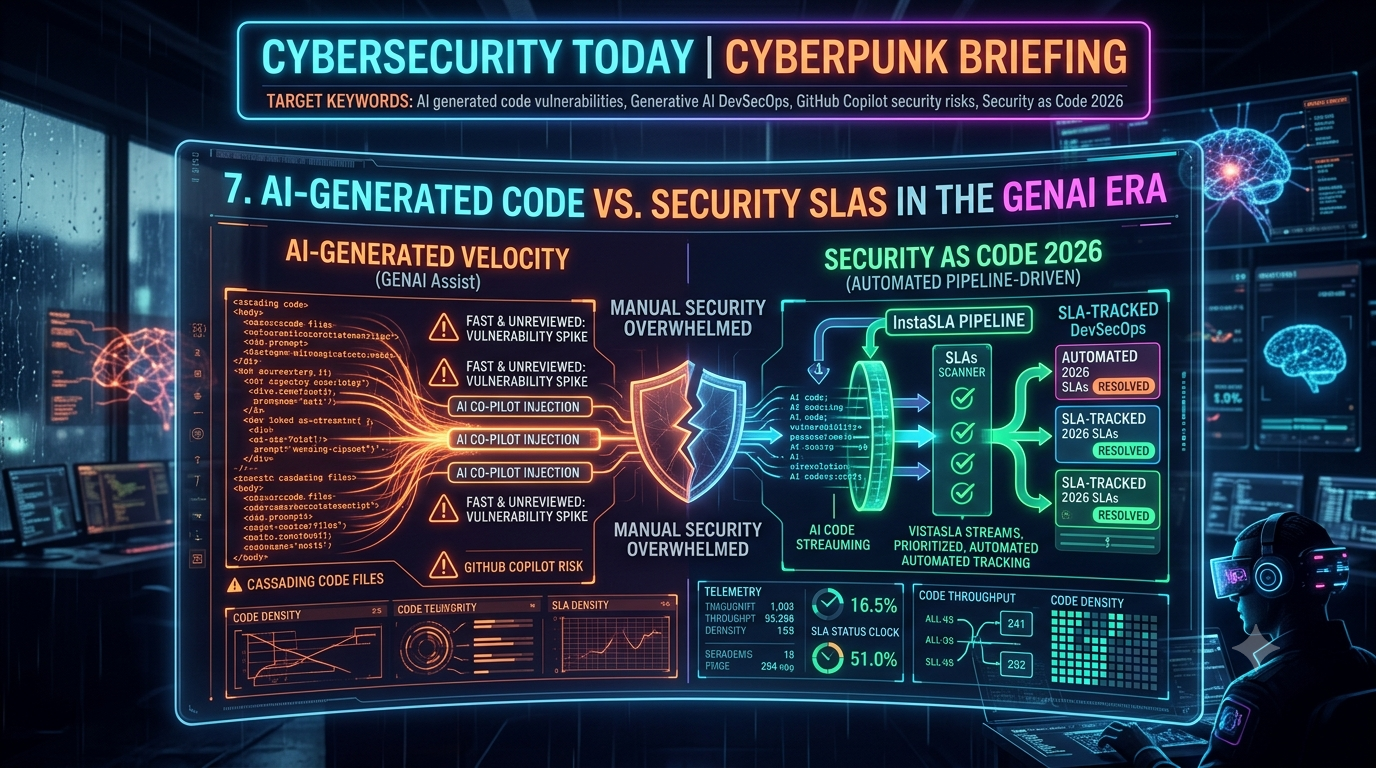
AI-Generated Code vs. Security SLAs in the GenAI Era
Generative AI coding assistants—GitHub Copilot, Cursor, Claude Code, Amazon Q, and dozens of competitors—have gone from novelty to default tooling across most engineering organizations. Developers now generate, refactor, and scaffold code at a pace that was unthinkable three years ago. But a growing body of independent research shows that this velocity is arriving with a security bill attached, and most organizations aren't set up to pay it on time.
This article looks at what the data actually says about AI-generated code security, why legacy manual review can't keep pace, and how engineering managers are turning to pipeline-driven, automated Service Level Agreement (SLA) enforcement—including platforms like InstaSLA—to close the gap.
The Velocity Paradox: More Code, More Vulnerabilities
The productivity case for AI coding assistants is real. GitClear's June 2026 "Maintainability Gap" report, which analyzed 623 million code changes from 2023–2026, found that developers who use AI heavily continue to out-produce non-users. But the same dataset shows the underside of that speed: refactoring (code "moved" for reuse) is down 70% against 2022 levels, code block duplication is up 81%, within-commit copy/paste is up 41%, and two-week code churn—code rewritten shortly after it was written—is up 15%. GitClear's CEO summed up the pattern bluntly: AI tends to generate something new for every request rather than reusing what already exists in the codebase, and legacy code increasingly goes untouched rather than maintained.
That matters for security because duplicated, unreviewed, rarely-refactored code is exactly the kind of code where vulnerabilities hide and multiply.
The Rise of AI-Generated Code Vulnerabilities
The clearest evidence comes from Veracode's 2025 GenAI Code Security Report, which tested output from more than 100 large language models across Java, JavaScript, Python, and C# on 80 security-relevant coding tasks. The result: AI-generated code introduced a security flaw in 45% of cases—roughly 2.74x the vulnerability rate of comparable human-written code. Java was the worst performer, failing 72% of the time, and cross-site scripting (XSS) defenses failed in 86% of relevant tests. A follow-up Veracode study in spring 2026 found this hasn't meaningfully improved: syntax correctness now exceeds 95%, but security pass rates remain stuck at roughly 55%, virtually unchanged from two years earlier. Models are getting better at writing code that works; they are not reliably getting better at writing code that's safe.
Enterprise data tells a similar story from a different angle. Application-security firm Apiiro analyzed tens of thousands of repositories across Fortune 50 companies between December 2024 and June 2025 and found that AI-assisted developers shipped code at three to four times the rate of their peers—while monthly security findings rose roughly tenfold, from about 1,000 to more than 10,000. The nature of the risk also shifted: syntax errors fell 76% and logic bugs fell 60%, but privilege-escalation paths rose 322% and architectural design flaws rose 153%. AI-assisted developers also exposed cloud credentials—Azure Service Principals and Storage Access Keys—at nearly twice the rate of their non-AI peers. In plain terms: AI is cleaning up the obvious, surface-level mistakes while quietly increasing the deep, structural ones that are hardest for both scanners and human reviewers to catch.
Why does this happen? The research points to a few consistent mechanisms:
- The comprehension gap. In "vibe coding," developers accept AI-suggested blocks without fully tracing the logic. If nobody on the team understood the code when it was written, nobody can accurately assess what it's exposed to.
- Contextual blindness. LLMs have no persistent model of a company's specific authentication middleware, trust boundaries, or IAM policies. Apiiro's researchers found AI agents routinely generate overly permissive access rules—for example, producing wildcard S3 permissions when asked for a Lambda function that "needs S3 access," because the model pattern-matches against public training data full of permissive defaults rather than reasoning about least privilege.
- Hallucinated security controls. Models can generate functions that look like validation but aren't—a
sanitize_input()that returns the raw string unchanged, for instance—giving developers false confidence that an XSS or injection risk has been handled.
Dependency and Supply-Chain Risk
AI assistants don't just write flawed logic; they can also point developers toward outdated or fabricated dependencies. Because models are trained on snapshots of public code, they can suggest importing library versions that were current at training time but carry since-disclosed CVEs by the time a developer accepts the suggestion.
A more novel and increasingly well-documented risk is slopsquatting: attackers registering the fake package names that LLMs are known to hallucinate, then waiting for an AI assistant to recommend that exact name to a developer. The academic research behind this is now substantial. A USENIX Security 2025 study of 16 code-generating models across 576,000 samples found average package-hallucination rates of 5.2% for commercial models and 21.7% for open-source models—and found that 43% of hallucinated names reappeared consistently when the same prompt was rerun, meaning these aren't random one-off errors but predictable, exploitable targets. A 2026 follow-up study by independent researcher Aleksandr Churilov tested five newer frontier models (including Claude and Gemini variants) and found hallucination rates had narrowed to a 4.6%–6.1% band across the board—and identified 53 hallucinated package names that were still unregistered and available for a malicious actor to claim.
This has moved from theory to practice. Security researchers have documented real hallucinated npm packages—such as one mimicking the legitimate eslint-plugin-unused-imports—that were registered, weaponized, and picked up real weekly download traffic from developers (and AI agents) trusting the suggestion. In one case reported by researchers at Aikido in early 2026, a hallucinated package name generated by an LLM conflating two real libraries appeared inside dozens of AI-generated "agent skill" files before anyone had registered it—showing how a hallucination can propagate through AI-generated tooling before an attacker even acts on it.
Separately, GitGuardian's 2025 scan of public GitHub activity found 28.65 million newly hardcoded secrets committed that year alone—a 34% year-over-year increase and the largest single-year jump on record, consistent with Apiiro's finding that AI-assisted commits leak cloud credentials at roughly twice the rate of human-only commits.
The Collapse of Legacy Manual Review
Security teams were never staffed for this volume. The widely cited industry benchmark—corroborated by BSIMM data and repeated in 2026 AppSec hiring research—puts the average ratio of application security engineers to developers at roughly 1:100, climbing to 1:200 or worse in high-growth engineering organizations. That ratio was already strained before generative AI; it does not survive developers shipping three to four times more code without a corresponding change in how security work gets triaged and fixed.
The practical result is a "find-but-never-fix" cycle. Detection has been automated for years—SAST, SCA, and secrets scanners run constantly—but remediation hasn't. Recent AppSec research notes that a majority of organizations are now sitting on backlogs of well over 100,000 unresolved findings, and a 2026 AppSec hiring analysis found that most job postings describe remediation as a manual "handoff" between security and engineering teams rather than an automated workflow. Regulatory data backs up how badly this plays out in practice: under the U.S. federal government's own directives, critical vulnerabilities on internet-facing systems are supposed to be fixed within 15 days and high-severity ones within 30 (per CISA's BOD 19-02). Yet a 2024 Bitsight analysis of real remediation timelines found that critical vulnerabilities actually took an average of 137 days to fix, and high-severity ones averaged 238 days—four to eight times slower than policy requires. That gap, between the SLA an organization claims to run and the SLA it actually delivers, is the same gap generative AI is now widening.
Faced with that math, security teams are pushed into one of two failure modes: rubber-stamping merges to avoid blocking developers, or drowning in alert fatigue while a backlog grows that nobody has the headcount to triage. Neither is sustainable at GenAI-driven code volumes. Matching machine-speed code generation requires machine-speed enforcement, not more manual reviewers.
Security as Code 2026: The Paradigm Shift
Security as Code (SaC) is the practice of encoding security policy—including SLA thresholds—as machine-readable rules enforced directly in the CI/CD pipeline, so the pipeline itself blocks noncompliant merges instead of routing a report to a human for follow-up. In the context of Generative AI DevSecOps, this means shifting from reactive ticketing toward proactive, automated enforcement at the exact moment AI-generated code is proposed for merge.
A vulnerability SLA defines the maximum time a flaw is allowed to remain unresolved based on severity. There's no single universal standard—CISA's own directives use 15/30-day windows for federal systems, while many private-sector security teams run tighter internal targets (commonly in the range of 24–72 hours for critical, actively exploitable issues; roughly a week for high severity; and 30–90 days for medium). What all of these frameworks share is the same underlying assumption: the SLA is only meaningful if it's actually tracked and enforced, and as the Bitsight data above shows, most organizations aren't managing to do that with spreadsheets and manual ticket routing even before AI tripled or quadrupled their code volume.
Scaling GenAI DevSecOps with InstaSLA
InstaSLA is built for exactly this gap: turning security SLA policy into an enforced, pipeline-native control rather than a spreadsheet someone updates on Fridays. Here's how pipeline-driven SLA enforcement addresses the specific failure modes documented above:
1. Automated Contextual Routing
When a SAST or SCA scanner flags a vulnerability in AI-generated code, InstaSLA routes the finding directly to the developer who committed it—with the specific lines involved, why they failed, and how to fix them, delivered inside the IDE or Git provider. This directly targets the "handoff" bottleneck that 2026 AppSec hiring research found dominates how remediation work still gets described: a manual routing step that doesn't scale at a 1:100 (or 1:200) security-to-developer ratio.
2. Intelligent Alert Grouping
GitClear's data shows AI assistants tend to repeat the same pattern across many files rather than reusing a single shared implementation—duplication is up 81% under AI-heavy authorship. When that happens with a security flaw (say, the same insecure logging call generated 50 times across a repo), InstaSLA groups the duplicates into a single "Fix Campaign" instead of 50 separate tickets, so the fix maps to the actual scope of the problem instead of flooding the backlog.
3. Pipeline Blocking
This is the core enforcement mechanism. If a merge would introduce a critical vulnerability, or if a repository already has a finding that has breached its SLA window, InstaSLA fails the build. The merge is hard-blocked until the debt is paid down. Given how far actual remediation timelines (137–238 days, per Bitsight) run behind stated policy (15–30 days, per CISA), a soft or advisory-only control isn't enough—the data suggests organizations only close that gap when the pipeline itself, not a person, enforces the deadline.
4. Visibility and Executive Reporting
InstaSLA provides real-time dashboards on which teams are meeting SLA targets and which are accumulating security debt, giving engineering leaders a way to identify teams that would benefit from training in secure prompting or AI-assisted review practices—rather than discovering the gap during an incident postmortem.
Implementing a Pipeline-Driven Strategy
Step 1: Treat AI code as untrusted by default. Zero Trust applies to AI output the same way it applies to any third-party code: it must be scanned, validated, and tested before it merges, regardless of how confident the assistant sounded.
Step 2: Define realistic, tracked SLAs. Work with your CISO to set remediation windows the organization can actually meet and measure—not aspirational numbers borrowed from a compliance framework. A tracked, moderately conservative SLA beats an aggressive one nobody enforces; the Bitsight data on real-world remediation times is a useful reality check here.
Step 3: Integrate Security as Code tooling. Deploy platforms like InstaSLA directly into GitHub, GitLab, or Bitbucket, and scan the delta on every pull request—including AI-generated diffs, which tend to be larger and touch more files per change than human-authored ones, according to Apiiro's enterprise research.
Step 4: Turn on automated blocking, gradually. Start in warn-only mode to build visibility and trust, then move to hard enforcement once developers have had time to adjust their AI-assisted workflow.
Step 5: Train developers in secure prompting. Explicitly injecting security constraints into a prompt—"use standard OAuth2 libraries," "sanitize inputs against XSS," "do not hardcode credentials"—measurably changes what the model produces. Given that Veracode's research shows models choosing the insecure default in roughly half of unguided tasks, this is one of the highest-leverage, lowest-cost interventions available.
Step 6: Lock down the supply chain. Given the slopsquatting research above, pin dependencies to verified lockfiles, verify package hashes in CI/CD, and require any AI agent with package-installation capability to work against an allowlist rather than resolving names automatically.
Conclusion
Generative AI coding tools are a genuine productivity gain—that part of the promise has held up. But the independent research is now consistent and specific: AI-generated code fails security tests in roughly 45% of cases, introduces sharply more privilege-escalation and design flaws even as it eliminates surface-level bugs, and comes with new supply-chain risks like slopsquatting that didn't exist three years ago. Meanwhile, the security teams meant to catch all of this are staffed at roughly one engineer per 100–200 developers, and even before AI accelerated code volume, real-world remediation was already running months behind stated policy.
Manual review and disconnected ticketing were not built for this ratio, and the data shows they haven't kept up. Automated, pipeline-driven SLA enforcement—platforms like InstaSLA enforcing rules at the merge gate—is how organizations are closing that gap: not by slowing AI-assisted development down, but by making sure the guardrails move at the same speed the code does.
Sources
- Veracode – 2025 GenAI Code Security Report
- Veracode – Spring 2026 GenAI Code Security Update
- Apiiro – 4x Velocity, 10x Vulnerabilities
- The Register – AI code assistants improve production of security problems
- GitClear – The Maintainability Gap: 2026 AI Code Quality Research
- Socket – New Study Identifies 53 Slopsquatting Targets Across 5 Frontier LLMs
- Cloud Security Alliance – Slopsquatting: AI Code Hallucinations Fuel Supply Chain Attacks
- Wikipedia – Slopsquatting (background and incidents)
- Aikido – Slopsquatting: The AI Package Hallucination Attack Already Happening
- PentesterLab – Appsec Ratio: Your Strategic North Star
- NHI MG – AppSec backlog growth is outpacing remediation capacity
- CISA – BOD 22-01: Reducing the Significant Risk of Known Exploited Vulnerabilities
- Rootshell Security – CISA Vulnerability Timeline (Bitsight remediation-gap data)
- Bolster AI – Vibe Coding Security Risks (GitGuardian secrets data)From SECURITY.md to Merge Gates: A 2026 Guide to Enforcing GitHub Vulnerability SLAs