DevSecOps Operations
Automating Security SLA Waivers: Replacing Spreadsheets with Defensible Workflows
Stop failing audits over undocumented exceptions. Learn how InstaSLA automates vulnerability SLA waivers and builds a defensible risk acceptance workflow
By InstaSLA Superadmin · Published · 10 min read
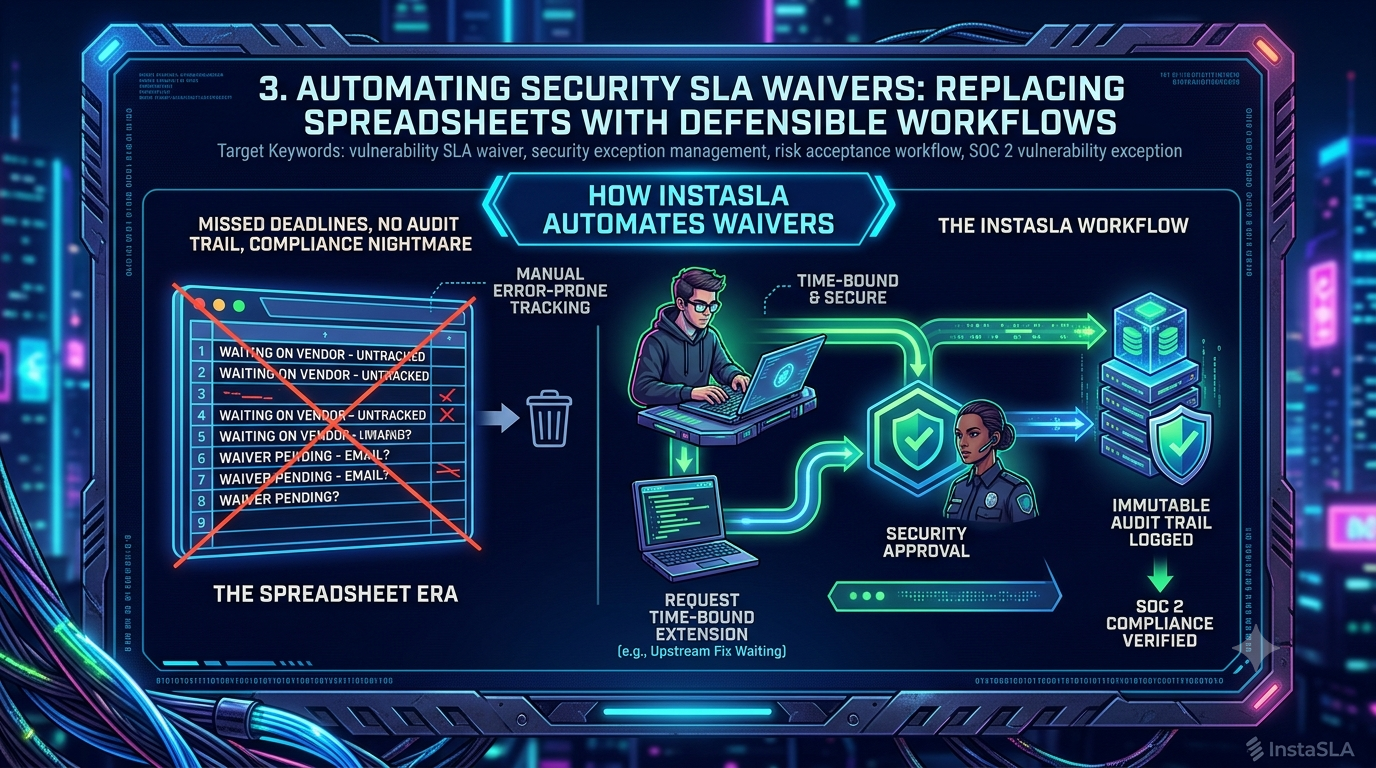
Automating Security SLA Waivers: Replacing Spreadsheets with Defensible Workflows
In modern software development, vulnerability Service Level Agreements (SLAs) serve as an organization's internal patching contract. They dictate how quickly a team must remediate a discovered flaw based on its severity. In an ideal world, every critical vulnerability is patched within 24 hours and every high-severity flaw is resolved within a week — that 24-hour figure is a real benchmark, but it's the aggressive end of the range that cloud-native teams aim for, not the norm most programs hit.
The data on where most programs actually land is sobering. According to the 2026 Verizon Data Breach Investigations Report, the median time to fully remediate a critical vulnerability rose to 43 days, up from 32 the year before, and only 26% of entries on CISA's Known Exploited Vulnerabilities (KEV) catalog were fully remediated during the reporting period — down from 38% the prior year. Qualys's 2026 Enterprise Patch & Remediation Benchmark puts mean time to remediate for complex enterprise applications (think Java, .NET, or Citrix stacks with heavy compatibility testing) at over five months. Meanwhile Mandiant's M-Trends 2026 report found that for a class of high-value-target vulnerabilities, attackers are now weaponizing exploits before a patch advisory is even fully published — pushing the effective "time to exploit" for those flaws into negative numbers. Engineering reality, in other words, is rarely as clean as the SLA policy assumes.
What happens when a developer physically cannot meet a patch deadline? Perhaps the vulnerability exists in an upstream open-source library and the vendor hasn't released a fix. Perhaps updating a core framework to remediate a medium-severity flaw would break a legacy application, requiring a multi-sprint refactor.
In these scenarios, organizations face a critical compliance junction. Missing an SLA deadline is a fast track to an audit finding, but relying on undocumented, informal workarounds is arguably worse — it turns a known issue into unmanaged risk with no paper trail. For compliance and security officers, the challenge is building a standardized, audit-ready way to handle these deviations. This article looks at why the legacy spreadsheet-and-Slack-thread approach to exception management is breaking down, how the compliance and threat landscape has shifted in 2026, and how platforms like InstaSLA are replacing fragile manual tracking with automated, defensible vulnerability SLA waiver workflows.
The True Cost of Undocumented Exceptions in SOC 2
To understand why a formal risk-acceptance workflow matters, it helps to understand how auditors actually categorize missed deadlines. Under SOC 2, an audit exception is any instance where a control either wasn't designed correctly or didn't operate as intended during the review period. There are three recognized types:
- System description misstatements — errors or omissions in how the organization describes its own systems or services, whether intentional or simply the result of stale documentation.
- Control design deficiencies — a required control is missing entirely, or exists but isn't designed to actually meet its objective.
- Operating effectiveness deficiencies — the control is designed correctly on paper but didn't run as intended during the audit window.
A vulnerability that stays open past its SLA deadline with no formal waiver on file falls squarely into the third category: the SLA policy itself was sound, but the evidence shows it wasn't followed. One exception doesn't automatically sink an audit — auditors issue a range of opinions (unqualified, qualified, adverse, or a disclaimer of opinion), and an isolated, well-explained gap is treated very differently from a recurring pattern. But a pattern of unexplained, undocumented misses is exactly what pushes an auditor toward a qualified or adverse opinion, because it signals the control isn't operating consistently over time.
The traditional reflex in many organizations is to handle these delays informally: a Slack message to a security engineer, a thumbs-up emoji, a verbal agreement to ignore the scanner alert for a month, or a note buried in a Jira comment or shared spreadsheet. This is a real problem for compliance, because an auditor cannot verify what they cannot see. If a control process ran but left no structured, retrievable record, the default assumption during testing is that it didn't happen. Without a formal system, exceptions also tend to age indefinitely — a waiver with no owner, no expiration date, and no remediation path stops being risk governance and becomes permanent unmanaged risk instead.
Why the Old SLA Playbook Is Under Pressure
The static "critical = 14 days, high = 30, medium = 60–90" baseline that many security programs still run on was built for a slower threat environment, and 2026's data suggests that baseline is aging badly.
A few numbers illustrate the gap:
- Vulnerability exploitation overtook stolen or reused credentials in 2025 to become the single most common way attackers gain initial access — the first time that's happened in the 19-year history of the Verizon DBIR, now accounting for roughly 31% of breaches.
- Edgescan's 2025 Vulnerability Statistics Report found that 45.4% of discovered enterprise vulnerabilities were still unpatched after twelve months, with 17.4% of that backlog rated high or critical severity.
- Hackuity's 2026 survey found that 97% of organizations tie remediation SLAs to severity, but only 56% report having any automated vulnerability management in place — a large gap between policy and execution.
Regulators are responding to that same pressure. On June 10, 2026, CISA issued Binding Operational Directive 26-04, "Prioritizing Security Updates Based on Risk," which formally supersedes both BOD 19-02 and the KEV-catalog directive, BOD 22-01. Where BOD 22-01 applied a flat remediation window to anything on the KEV list, BOD 26-04 requires federal civilian agencies to score every vulnerability on four variables — whether the asset is publicly exposed, whether the flaw is in the KEV catalog, whether exploitation can be automated, and how much technical impact a successful exploit grants — and assigns a graduated deadline accordingly. The most dangerous combination (publicly exposed, actively exploited, automatable, and capable of granting full system control) now carries a 3-day remediation window with mandatory forensic triage; lower-risk combinations get 14 or 60 days, or in some cases deferral. Agencies have until roughly December 2026 to be in full compliance with the directive's timelines.
BOD 26-04 is only binding on federal agencies, but it's a useful signal for everyone else: it confirms that "SLA deadline" is becoming a moving target driven by live risk signals rather than a static number attached to a severity label — which makes manual, spreadsheet-based tracking even harder to sustain and makes the case for automated, auditable waiver workflows stronger, not weaker.
Defining the Vulnerability SLA Waiver
A vulnerability SLA waiver — often called a security exception — is a documented and approved deviation from a required remediation baseline. It is not a permission slip to ignore risk indefinitely. It's a formal risk-governance decision that officially "stops the clock" on an SLA timer when remediation is temporarily impossible.
ISO/IEC 27001:2022 gets at the same idea from a different angle. Annex A control 8.8, "Management of Technical Vulnerabilities," requires organizations to obtain timely information about technical vulnerabilities affecting systems in use, evaluate the organization's actual exposure to each one, and take appropriate action — which can mean patching, applying a compensating control, or formally accepting the risk, but not simply leaving the finding open with no decision attached. A waiver process is, in effect, how an organization operationalizes that "evaluate exposure, then act" requirement in a way an auditor can verify after the fact.
A defensible exception management process needs several components to satisfy both SOC 2 and ISO 27001 expectations:
- Business justification — a clear explanation of why standard compliance isn't immediately possible (e.g., no vendor fix available, or remediation risks system stability).
- Compensating controls — immediate actions taken to reduce exposure while the underlying issue remains unresolved (a WAF rule, disabling a feature, network segmentation).
- Clear ownership — every exception assigned to an accountable individual or team responsible for eventually closing it.
- Expiry and review dates — a time-bound limit that prevents the exception from becoming permanent by default.
- Appropriate approvals — a record of review by the relevant security, risk, and compliance stakeholders, scaled to the severity of the flaw.
Done well, this keeps temporary gaps visible instead of hidden, and makes clear that leadership is actively accepting a defined risk rather than letting one accumulate by neglect.
Automating the Risk Acceptance Workflow
Building this process manually with ticketing systems and spreadsheets is workable at small scale, but it's fragile — tasks get missed whenever they depend on someone remembering to follow up. Platforms like InstaSLA aim to close that gap by turning security exception management into a structured, largely automated process.
1. Standardized developer request. When a developer realizes they can't meet an upcoming SLA deadline, they open a waiver request from within their normal workflow instead of sending an unstructured Slack message. The system prompts for the required context up front: the vulnerability identifier (CVE), severity, affected assets, and the length of the requested exception, along with the business justification and proposed mitigating controls. That structured intake means the security team has what it needs to make a risk-based call without a round of back-and-forth.
2. Automated routing and approval. The request routes to the appropriate approver based on predefined policy — a low-severity waiver might go straight to an engineering manager, while a critical production vulnerability routes to the CISO or a formal risk committee. Once approved, the SLA timer is officially paused for that finding, which keeps automated escalations and build-blocking checks from unnecessarily penalizing the developer while the exception is active.
3. Enforced, time-bound expiration. Exceptions shouldn't be permanent by default. As an approved waiver approaches expiry, the platform alerts both the owner and the security team, forcing a decision: remediate now that a fix is available, renew the exception with fresh approval, or revoke it if the original business justification no longer holds. That forced periodic review is what keeps aging vulnerabilities from silently piling up in the backlog.
4. An immutable audit trail. This is the function that matters most when a SOC 2 or ISO 27001 audit actually happens. Instead of reconstructing the story from scattered Jira comments and email threads, compliance officers can pull a centralized record showing the vulnerability's discovery date, the original SLA deadline, the documented justification for the extension, the compensating controls applied, who approved the waiver, and the eventual expiration and remediation outcome. That record is what demonstrates to an auditor that the control was operating effectively even when a specific deadline was missed — the organization wasn't ignoring the risk, it was managing it through a structured, defensible process.
The Bottom Line
Missing an SLA is sometimes unavoidable — vendor delays and legacy architecture don't care about a patching policy. Failing to document that miss, on the other hand, is entirely preventable, and it's the gap auditors and attackers are both increasingly positioned to exploit: attackers because exploitation windows are shrinking faster than most remediation programs can keep pace with, and auditors because an undocumented gap reads as an operating effectiveness deficiency regardless of how good the underlying reasoning was. As remediation deadlines themselves start shifting from flat, severity-based numbers toward the kind of dynamic, risk-scored timelines CISA is now mandating for federal agencies under BOD 26-04, tracking exceptions in a spreadsheet gets harder to defend every quarter. Replacing that spreadsheet with a structured, automated, time-bound waiver workflow turns a potential audit finding into a demonstration of mature security governance.
Sources
- 2026 Verizon Data Breach Investigations Report — vulnerability exploitation as leading initial access vector, remediation timing
- CISA — BOD 26-04: Prioritizing Security Updates Based on Risk — four-variable risk model, remediation timelines
- CISA — BOD 22-01 (revoked) — prior KEV catalog directive
- Edgescan 2025/2026 Vulnerability Statistics Report — unpatched vulnerability backlog data
- Qualys 2026 Enterprise Patch & Remediation Benchmark — enterprise application MTTR
- Mandiant M-Trends 2026 — time-to-exploit data
- ISO/IEC 27001:2022 Annex A 8.8 — Management of Technical Vulnerabilities
- Drata — SOC 2 Audit Exceptions — SOC 2 exception types and auditor opinionsCISA BOD 26-04: How to Meet the New 3-Day Remediation SLA in GitHub