DevSecOps Operations
Establishing Vulnerability Remediation SLAs for Microservices Architectures
Establish clear security SLAs for microservices. Learn how to map cloud-native vulnerabilities directly to service owners and eliminate routing chaos
By InstaSLA Superadmin · Published · 12 min read
Establishing Vulnerability Remediation SLAs for Microservices Architectures
The transition from monolithic architectures to cloud-native microservices has reshaped modern software engineering. Breaking applications into fine-grained, independently deployable services has bought organizations real agility and release velocity — but it has also quietly broken the way most teams handle vulnerability remediation.
The scale of the underlying problem keeps growing. A record 48,185 CVEs were published in 2025, and high/critical-severity application and API vulnerabilities still take an average of nearly 55 days to close industry-wide. When an enterprise scales from a single repository to hundreds or thousands of containerized services owned by dozens of autonomous squads, "microservices vulnerability management" stops being a scanning problem and becomes a routing problem: security findings pile up in unassigned queues, ownership becomes murky, and remediation deadlines are missed not because teams don't care, but because nobody can tell, fast enough, who is supposed to act.
This article lays out a practical framework for setting vulnerability remediation SLAs in microservices environments, explains how the U.S. government itself just overhauled its own approach to this exact problem, and shows how automated routing platforms like InstaSLA operationalize that framework at scale.
The Cloud-Native Security Shared Responsibility Crisis
In public cloud environments, the industry has long worked from the Cloud Service Provider Shared Responsibility Model: the provider secures the cloud itself (physical infrastructure, hypervisors, hardware), while the customer secures what runs in the cloud (data, application code, identity, configuration).
A parallel, internal version of that same split has emerged inside microservices organizations, between central Platform/SecOps teams and distributed product engineering squads.
| Platform & SecOps Team | Product Engineering Squads (Service Owners) |
|---|---|
| Security tooling & scanners (SAST, SCA, CSPM) | Application source code & logic fixes |
| Enterprise SLA policy & governance | Dependency and library upgrades (package.json, pom.xml, go.mod) |
| CI/CD security pipeline gates & guardrails | Container base image maintenance & runtime configuration |
The split sounds clean on paper. In practice, it only works if there's a reliable mechanism connecting a scanner finding in repository X to the specific squad that owns repository X — and that mechanism is exactly what breaks down at scale.
The Breakdown of Centralized Security Triage
In a monolithic architecture, a security engineer could triage an alert, judge its severity, and file a ticket with the one team that owned the codebase. In a microservices ecosystem, that centralized model collapses under its own weight.
When a critical vulnerability is disclosed in a widely used shared library — Log4Shell (CVE-2021-44228) in Log4j is the canonical example — an automated scanner can trigger thousands of individual findings across hundreds of repositories in a single day. No central security team can manually inspect every repository, work out which product team owns each affected service, confirm whether that service is actually running in production, and file individual tickets on any useful timeline.
This isn't a hypothetical risk. According to Black Duck's 2026 Open Source Security and Risk Analysis (OSSRA) report, 65% of organizations surveyed experienced a software supply-chain attack in the past year, and the average commercial codebase's file count has roughly quadrupled over five years as dependency graphs have exploded. Sonatype's 2026 State of the Software Supply Chain report similarly found more than 454,000 new malicious open-source packages discovered in 2025 alone — a 75% year-over-year increase, with state-sponsored groups like Lazarus among those publishing typosquatted packages to npm and PyPI. Every one of those findings has to land on the right desk.
When security teams try to brute-force the problem by mass-generating Jira tickets, engineering squads experience severe alert fatigue. Tickets bounce between teams, get marked "Not Our Service," or sink to the bottom of a backlog — and vulnerabilities stay unpatched in production long past whatever SLA was supposed to govern them.
The Mechanics of the Distributed Vulnerability Routing Nightmare
1. Ephemeral Services and Repository Sprawl
Microservices architectures encourage polyrepo strategies. A mid-sized engineering org can easily maintain hundreds of GitHub repositories alongside serverless functions, edge proxies, and cron workers — and those services are constantly created, renamed, split, or decommissioned. Static tools that map vulnerabilities to a fixed project name quickly drift out of sync with the org chart.
2. The "Orphaned Service" Problem
Squads get reorganized, merged, or disbanded. Code written two years ago by a team that no longer exists can still be running in production, generating revenue, serving live traffic — with no active squad formally accountable for it. When a scanner flags a critical finding in an orphaned service, the alert enters limbo. Without explicit service-owner accountability, nobody acts on it.
3. Ambiguous Ownership Metadata
Many tools lean on repository CODEOWNERS files to route alerts, but those files are notoriously stale — a CODEOWNERS entry can point to a GitHub team handle that was deleted in a restructuring months earlier. And CODEOWNERS maps code to developers, not to the service-level context remediation actually needs: who's on call, which squad owns the deploy pipeline, which Slack channel the team actually watches.
4. Context Collapse and False Urgency
Not every microservice carries the same risk. A high-severity flaw in an internet-facing payment gateway needs same-day attention; the identical flaw in an air-gapped, internal batch-processing worker may not. This is precisely the gap the industry built two complementary scoring systems to close:
- CVSS (Common Vulnerability Scoring System), maintained by FIRST, scores technical severity on a 0–10 scale. The current version, CVSS v4.0 (released November 2023), replaced the old temporal metric group with a dedicated Threat metric group and added supplemental metrics — including Automatable, which flags whether an exploit chain can be scripted at scale.
- EPSS (Exploit Prediction Scoring System), also maintained by FIRST, is a machine-learning model that estimates the probability a given CVE will actually be exploited in the wild in the next 30 days. It publishes a 0–1 score, updated daily, for every published CVE. EPSS is now on version 4 (released March 2025); FIRST reports that version 3 alone improved predictive performance by roughly 82% over its predecessor.
CVSS answers "how bad could this be?" EPSS answers "how likely is someone to actually try it?" A vulnerability with a moderate CVSS score of 6.5 but an EPSS score of 0.76 — meaning public proof-of-concept code already exists — deserves more urgency than a CVSS 9.8 with a near-zero EPSS score sitting on an isolated internal system. Tools that report both findings with equal panic train developers to ignore alerts altogether.
Architecting SLA Frameworks for Microservices
Effective microservices vulnerability management SLAs move away from flat, one-size-fits-all deadlines toward context-aware, risk-based timelines built on three dimensions: severity, asset exposure, and exploitability.
The table below is a common illustrative starting point — most organizations tune the exact windows to their own risk tolerance:
| Severity / Context | Internet-Facing / High Impact | Internal / Isolated Service |
|---|---|---|
| Critical (CVSS 9–10) | 24 hours | 72 hours |
| High (CVSS 7–8.9) | 7 days | 14 days |
| Medium (CVSS 4–6.9) | 30 days | 60 days |
| Low (CVSS 0.1–3.9) | 90 days | Best effort / 180 days |
Key principles for cloud-native security SLAs
- Differentiate ingress vs. internal workloads. Services sitting behind a public API Gateway or load balancer need materially tighter windows than backend services that only communicate over an encrypted internal service mesh (Istio, Linkerd) with mutual TLS.
- Blend CVSS with EPSS, not CVSS alone. A hybrid approach — using EPSS to escalate or de-escalate CVSS-based deadlines — is now widely recommended precisely because CVSS measures technical severity, not real-world exploitation likelihood, and the two frequently disagree.
- Tie SLAs to deployment pipeline gates. An SLA that's only a calendar deadline is a suggestion. If a "Critical" finding breaches its remediation window, the CI/CD pipeline should automatically block non-emergency deploys for that specific service until the fix lands.
The federal government just validated this exact model
This isn't only industry best practice anymore — it's now U.S. federal policy. On June 10, 2026, CISA issued Binding Operational Directive 26-04, "Prioritizing Security Updates Based on Risk," which formally retires the older flat-deadline approach (BOD 22-01's Known Exploited Vulnerabilities catalog and BOD 19-02's CVSS-based windows) in favor of a four-variable risk model. For every vulnerability, federal civilian agencies must now assess:
- Asset exposure — is the vulnerable system publicly reachable?
- KEV status — is the CVE listed in CISA's Known Exploited Vulnerabilities catalog?
- Exploit automation — can an adversary script the entire attack chain?
- Technical impact — does successful exploitation hand the attacker partial or total control?
Depending on how many of those criteria a finding meets, BOD 26-04 assigns remediation windows as tight as 3 days (with mandatory forensic triage) down to full deferral for the lowest-risk combinations — replacing CVSS score alone as the primary prioritization driver. Agencies have until roughly December 2026 to be fully compliant with the new timelines.
CISA's own stated rationale for the change is worth noting: the directive explicitly cites the shrinking gap between vulnerability disclosure and real-world weaponization as the reason flat deadlines no longer work. That's the same pressure driving private-sector teams toward context-aware SLAs — and it comes with a sobering data point attached. Verizon's 2026 Data Breach Investigations Report found that only 26% of catalogued KEV vulnerabilities were fully remediated in 2025, down from 38% the year before — evidence that even known, actively exploited vulnerabilities are losing the remediation race industry-wide when routing and ownership aren't automated.
Solving the Routing Nightmare: How InstaSLA Operationalizes Microservice Security
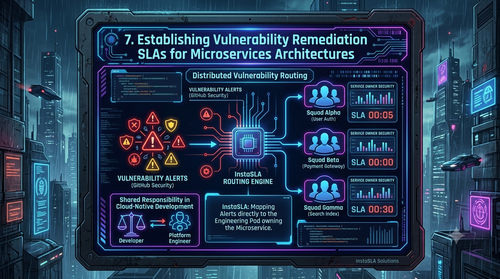
The fundamental bottleneck in cloud-native vulnerability management isn't scanning — it's distributed vulnerability routing. Enforcing SLAs requires an intelligent layer between security scanners (GitHub Advanced Security, Dependabot, CodeQL, Trivy, Snyk) and the engineering teams who actually build and maintain each service. That's the layer InstaSLA provides: an automated SLA routing and governance engine purpose-built for distributed software architectures.
1. Direct GitHub-to-squad ownership mapping
InstaSLA eliminates manual triage by mapping GitHub alerts directly to the engineering pod that owns the affected microservice. Rather than relying solely on static CODEOWNERS files, it integrates with modern software catalogs — tools like Backstage (originally built at Spotify and now a CNCF graduated project), Port, or OpsLevel — plus version-control metadata, to maintain a living source of truth for service ownership.
When GitHub flags a vulnerable dependency or leaked secret in services/auth-service, InstaSLA determines who owns it, who's the active on-call engineer, and which Slack channel the squad actually monitors — in seconds, not days.
2. Context-aware escalation and alert grouping
Rather than firing 50 individual notifications for 50 instances of the same vulnerable library, InstaSLA groups findings by root cause and service context. If a squad owns five microservices that all consume the same vulnerable base image, InstaSLA consolidates that into one notification containing the CVE details, the affected services and environments, the live SLA countdown, and a direct remediation path — such as the specific base-image tag to upgrade to.
3. Automated SLA tracking and governance
InstaSLA continuously calculates SLA compliance organization-wide, giving engineering managers and platform architects visibility into Mean Time to Remediate (MTTR) per service and per squad, vulnerabilities nearing SLA breach, and accumulated security debt — the kind of visibility that lets leaders build vulnerability-reduction time into sprint planning before debt piles up rather than after.
4. Preventing "orphaned service" breaches
When an alert lands on a repository with no active squad mapping, InstaSLA doesn't let it disappear into limbo. It triggers an orphan-alert workflow, escalating the finding to the relevant Domain Architect or Platform Lead and logging a governance ticket to assign the service a permanent owner.
Step-by-Step Blueprint for Platform Engineering & Security Teams
Step 1: Establish a unified software catalog
Before automating routing, you need to know what services exist and who owns them. Stand up a centralized catalog — Backstage, Port, or GitHub organization metadata all work — that enforces mandatory fields for every service:
service_nameowner_team(e.g.@org/payments-squad)tier(e.g. Tier 1: critical customer flow, Tier 3: internal batch processing)repository_urlslack_channel
Step 2: Integrate security scanners with InstaSLA
Connect your scanning tools — Dependabot, CodeQL, secret scanning, container registries — directly to InstaSLA via webhook, so findings process in real time as code is pushed or images are built.
Step 3: Define context-aware SLA rules
Configure severity-based timelines mapped to service tier:
# Example InstaSLA policy configuration
policies:
  - name: Tier-1 Ingress Microservices
    match:
      service_tier: 1
      ingress: public
    slas:
      critical: 24h
      high: 7d
      medium: 30d
  - name: Standard Microservices
    match:
      service_tier: 2
    slas:
      critical: 72h
      high: 14d
      medium: 60d
Step 4: Automate notification routing and developer workflows
InstaSLA calculates the deadline from policy, routes an actionable alert straight to the owning squad's Slack channel and Jira board, and gives developers a deep link to the code location plus an auto-generated pull request when a fix version is available.
Step 5: Implement automated pipeline enforcement
Close the loop by wiring InstaSLA's compliance status into CI/CD (GitHub Actions, GitLab CI, ArgoCD). If a service tries to deploy while carrying a vulnerability that has breached its active SLA, the pipeline fails the build and cites the specific violation — turning the policy from a guideline into an actual guardrail.
The Business Impact: Moving From Panic to Velocity
It's worth being precise about the baseline this kind of automation is trying to beat, because the industry-wide numbers are not good:
- High/critical-severity application and API vulnerabilities take an average of 54.81 days to remediate, and device/network vulnerabilities average 39 days (Edgescan, 2026 Vulnerability Statistics Report).
- The median "flaw half-life" — the time it takes organizations to fix half of their outstanding vulnerabilities — sits at 243 days, according to Veracode's 2026 State of Software Security report, with 82% of organizations now carrying accumulated security debt.
- Qualys's 2026 analysis of over a billion remediation records found that manual remediation processes failed to keep pace with attackers 88% of the time for actively weaponized vulnerabilities.
- As noted above, only 26% of CISA KEV-listed vulnerabilities were fully remediated in 2025 — down from 38% the year before (Verizon 2026 DBIR).
Those numbers describe organizations still relying substantially on manual triage and static tickets. The specific gains any given team sees from automating ownership mapping and SLA enforcement will vary with their starting point, but the direction is consistent across the industry's own data: teams that know immediately who owns a finding, and that tie SLA breaches to real pipeline consequences, close the gap between disclosure and remediation faster than teams still playing detective across hundreds of repositories. That, concretely, is what routing automation is for — not eliminating vulnerabilities, but eliminating the days or weeks lost simply figuring out whose problem one is.
Conclusion
Building a scalable, cloud-native architecture without an automated vulnerability routing strategy is a recipe for exactly the kind of stalled remediation the industry's own benchmarks now document — and, as of CISA's BOD 26-04, exactly the kind of stalled remediation the U.S. federal government has formally decided to stop tolerating. Context-aware, risk-tiered SLAs are no longer a private-sector best practice competing against simpler alternatives; they're the direction the entire field, public and private, is converging on.
By establishing a clear internal shared-responsibility model, defining context-aware remediation SLAs grounded in both CVSS and EPSS, and using a platform like InstaSLA to map every alert directly to the engineering squad accountable for it, platform leaders can turn service-owner security from a bottleneck into a routine, automated part of how the organization ships software.
Sources
- Edgescan, 2026 Vulnerability Statistics Report
- Veracode / Pixee, MTTR in cybersecurity, 2026 benchmarks
- Verizon, 2026 Data Breach Investigations Report (via Tenable's BOD 26-04 analysis)
- CISA, BOD 26-04: Prioritizing Security Updates Based on Risk
- CISA, BOD 26-04 Implementation Guidance
- FIRST.org, EPSS and CVSS v4.0
- Black Duck, 2026 Open Source Security and Risk Analysis (OSSRA) Report
- Sonatype, 2026 State of the Software Supply Chain Report