DevSecOps Operations
Platform Engineering: Building the Alert Ownership Matrix in GitHub
Eliminate AppSec bottlenecks in your IDP. Learn how to map GitHub repos to engineering pods with InstaSLA and build a clear Alert Ownership Matrix
By InstaSLA Superadmin · Published · 13 min read
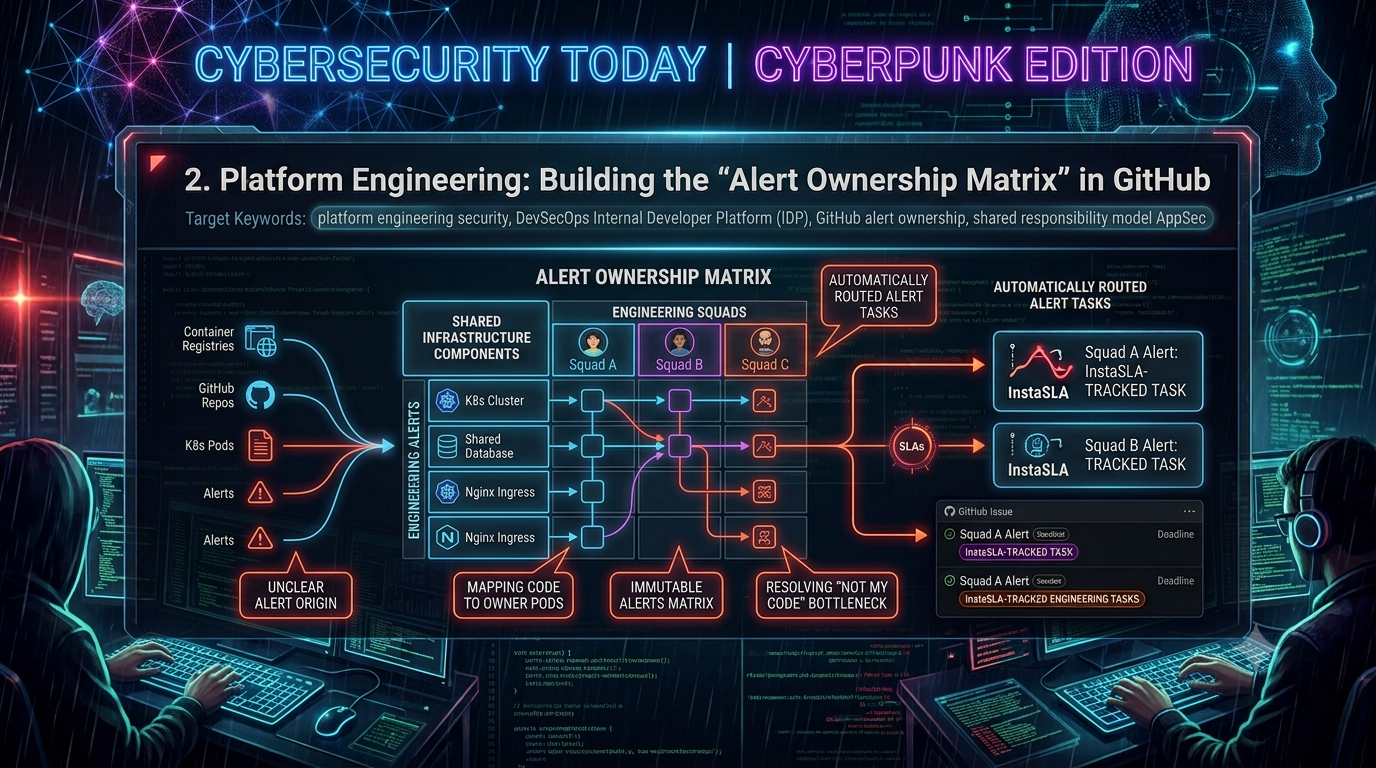
Platform Engineering: Building the Alert Ownership Matrix in GitHub
In the evolution of modern software architecture, the transition from monolithic applications to decentralized microservices has solved countless scaling and velocity problems. However, it has also created a massive, distributed headache for security and platform teams. Gartner projects that by 2026, 80% of large software engineering organizations will have established a dedicated platform team, up from just 45% in 2022 — and its 2026 Hype Cycle for Platform Engineering found that 81% of engineering leaders already say platform engineering delivers moderate-to-high value specifically in automating security and compliance workflows. The demand is real, and it's growing because the old model of routing alerts is breaking down.
When an organization shifts to a DevSecOps Internal Developer Platform (IDP) model, infrastructure becomes a shared commodity, and deployments become highly automated. But when a security scanner flags a critical vulnerability in a container running on a shared cluster, a frustrating organizational friction emerges: the "not my code" syndrome. Platform engineers are drowning in alerts for applications they didn't write, while feature squads remain oblivious to the vulnerabilities their code introduced. To scale platform engineering security, organizations must eliminate this triage bottleneck. The solution lies in building an immutable "Alert Ownership Matrix" — a systemic mapping of repositories and registries directly to engineering pods — and using an execution layer like InstaSLA to enforce it.
The "Not My Code" Syndrome in Modern Microservices
To understand the necessity of an Alert Ownership Matrix, we must first diagnose why the shared responsibility model AppSec frequently breaks down in microservice architectures — and the data on this is now much clearer than it was even a year ago.
In a traditional, siloed environment, the path from source code to production was heavily gated. Security teams ran static analysis on a monolith, reviewed the findings, and handed a spreadsheet to a singular engineering director. Today, a mature IDP empowers dozens of autonomous feature squads (or "pods") to scaffold repositories, build containers, and deploy to shared Kubernetes clusters multiple times a day without opening a single IT ticket.
This self-service model is excellent for developer velocity, but it creates a massive disconnect in alert routing, and the volume backs that up. Verizon's 2026 Data Breach Investigations Report (DBIR), which analyzed more than 22,000 confirmed breaches, found that the number of vulnerability instances organizations had to deal with grew from roughly 68.7 million in 2022 to 527 million in 2025 — far outpacing any realistic improvement in patching capacity. OX Security's 2026 Application Security Benchmark separately found organizations now average 865,398 open security alerts each, up 52% year over year. When nobody owns an alert queue that size, most of it simply doesn't get worked.
Consider a typical DevSecOps scenario:
- The Deployment: Squad Alpha deploys a new Go microservice to a shared production namespace.
- The Discovery: A runtime scanner or a Software Composition Analysis (SCA) tool detects a high-severity CVE in an outdated logging library within that microservice's container.
- The Triage Bottleneck: The scanner fires an alert into a central security dashboard or a shared Slack channel monitored by Platform Engineering or SecOps.
The platform engineer looking at the alert knows that a vulnerable container exists in the prod-services namespace. But they do not know who wrote the code, who merged the pull request, or who owns the business logic. They must pause their platform work, reverse-engineer the CI/CD pipeline, find the source GitHub repository, look at the commit history, identify Squad Alpha, and manually create a Jira ticket.
When a squad receives a manual ticket days later, the context is lost. Developers reflexively push back: they didn't configure the base image, or the vulnerable code lives in a shared library that isn't really "theirs." This triage bottleneck causes Mean Time to Remediation (MTTR) to skyrocket, and the numbers show it's a slow-moving crisis rather than a hypothetical one:
- Verizon's 2026 DBIR found the median time to fully remediate a critical vulnerability rose to 43 days, up from 32 the year before — and only 26% of vulnerabilities on CISA's Known Exploited Vulnerabilities (KEV) catalog were fully remediated, down from 38%.
- Edgescan's 2026 Vulnerability Statistics Report put the average MTTR for high- and critical-severity application and API vulnerabilities at 54.81 days across 2025.
- Veracode's 2025 research found the average time to fix a flaw has grown 47% since 2020, from 171 days to 252 days, and that 82% of organizations now carry meaningful security debt.
- Time-to-exploit is moving the opposite direction: Mondoo's 2026 research found it has collapsed from 63 days to roughly 5 days between disclosure and active exploitation.
Turning theoretical security debt into a tangible breach risk isn't a rhetorical flourish anymore — for the first time in the DBIR's 19-year history, vulnerability exploitation (31% of breaches) has overtaken both credential abuse (13%) and phishing (16%) as the leading way attackers get in.
The Concept of the "Alert Ownership Matrix"
If a DevSecOps Internal Developer Platform (IDP) provides the "paved road" for developers to ship code, it must also provide the guardrails. A core principle of platform engineering security is that the team that writes and deploys the code must own the operational and security posture of that code.
The Alert Ownership Matrix is the architectural enforcement of this principle. It is a definitive, programmatic mapping that answers one simple question for every asset in your infrastructure: If this asset triggers a security alert, whose pager rings?
A robust matrix maps four primary dimensions:
- Source Code (GitHub Repositories): The origin of the application logic.
- Artifacts (Container Registries/Images): The packaged code ready for deployment.
- Infrastructure (Namespaces/Cloud Resources): Where the code actually runs.
- Human Accountability (Engineering Pods/Squads): The specific group of developers responsible for the asset, typically defined by an Identity Provider (IdP) or GitHub Teams.
By linking these dimensions, an IDP can establish a chain of custody. If a vulnerability is found in a running container, the matrix automatically traces the container back to its source repository, identifies the GitHub Team mapped to that repository, and routes the alert directly to them, bypassing the platform team entirely.
Laying the Groundwork: Establishing GitHub Alert Ownership
The foundation of the Alert Ownership Matrix begins in your source control system. For organizations using GitHub, establishing GitHub alert ownership requires strict metadata hygiene. Platform engineering leads must configure the IDP to automatically enforce ownership tagging at the moment a new repository is scaffolded.
1. Mandatory CODEOWNERS Files
Every repository created via the IDP should automatically include a CODEOWNERS file. GitHub's own documentation is precise about how this works: the file must live in .github/, the repository root, or docs/, in that search order, and it maps file paths or patterns to specific GitHub usernames or teams. A named team must have explicit write access to the repository for the mapping to take effect, even if its individual members already have access through another route — a common configuration mistake that silently breaks ownership routing. If the repository belongs to the Payments pod, the root directory should be assigned to @org/payments-pod.
It's worth being precise about what CODEOWNERS actually does, because it's easy to over-credit it: GitHub built the feature primarily to auto-request pull-request reviewers, not to route security alerts. It has no native concept of severity, SLA, or escalation — it can tell you who reviews changes to a path, which is a reasonable proxy for ownership, but it was never designed to be a triage or alerting system on its own. That's precisely the gap an execution layer needs to fill: CODEOWNERS is good raw material for the matrix, not the matrix itself.
2. Repository Topics and Labels
Metadata is crucial for automation. Platform teams should enforce the use of GitHub Repository Topics to define business domains, data sensitivity, and, most importantly, team ownership (e.g., owner-squad-alpha, tier-1-service, pci-scope). This data makes the repository programmatically queryable by downstream security tools.
3. CI/CD Provenance
To bridge the gap between GitHub and the container registry, the CI/CD pipeline (e.g., GitHub Actions) must inject metadata into the built artifacts. When a container image is pushed to the registry, it should be tagged with labels that point back to the source repository URL, the specific commit SHA, and the GitHub Team that triggered the build.
While these steps organize the data, they do not inherently solve the triage problem. GitHub native tooling and traditional SAST/SCA scanners are excellent at generating alerts, but they often lack the orchestration capabilities to enforce deadlines, track historical compliance, or escalate ignored issues across hundreds of repositories. To truly eliminate the bottleneck, you need an execution layer.
Using InstaSLA to Automate the Execution Layer
Chief Technology Officers and Platform Leads reviewing their security posture often realize they have a "tool sprawl" problem. They have scanners for code, scanners for containers, and scanners for the cloud, creating an alert cannon that fires directly at the platform team.
This is where a specialized execution layer like InstaSLA becomes critical. InstaSLA installs as a GitHub App and acts as the enforcement engine for your Alert Ownership Matrix. It takes the passive metadata you established in GitHub and turns it into active, SLA-backed workflows.
Here is how Platform Engineering teams use InstaSLA to automate the shared responsibility model AppSec:
Step 1: Direct Mapping of Repositories to Pods
InstaSLA ingests the metadata from your GitHub organization. Rather than relying on a centralized security analyst to read a CVE and guess the owner, platform teams configure InstaSLA to read the repository topics, CODEOWNERS, or custom IDP mappings.
When an SCA tool flags a critical vulnerability in repo-payment-gateway, InstaSLA intercepts the alert. It consults the matrix, identifies that @org/payments-pod owns this repository, and immediately routes the alert to that specific squad's queue. The platform team is entirely removed from the triage loop.
Step 2: Enforcing Severity-Based SLAs
Routing the alert is only half the battle; ensuring it gets fixed is the other. In a "not my code" culture, developers might see an alert and simply ignore it, assuming it is someone else's problem.
InstaSLA allows platform engineers to define SLA-as-Code. You can codify a policy stating that any vulnerability tagged as "Critical," or matching the CISA Known Exploited Vulnerabilities (KEV) list, must be resolved within a set window. How aggressive that window should be is worth grounding in real benchmarks rather than picking a number arbitrarily: Hackuity's 2026 research found 97% of organizations already tie remediation SLAs to severity, but only 56% report having any automated enforcement of those SLAs — which is exactly the gap between "we have a policy" and "the policy gets followed." A 72-hour window is reasonable for KEV-listed, internet-facing findings; federal civilian agencies operate under CISA's Binding Operational Directive 22-01, which sets a similar short fuse for actively exploited vulnerabilities specifically. Once InstaSLA routes the alert to the feature pod, the countdown begins. The squad gets clear, visible queues showing exactly what is due today and what is overdue.
Step 3: Automating Escalations (Preventing Alert Rot)
If a feature squad ignores the alert and the deadline approaches, InstaSLA triggers automated escalations. Instead of a platform engineer having to manually nag a developer in Slack, the system automatically notifies the engineering manager of the pod. If the SLA breaches, the escalation can roll up to the Director level.
This creates true accountability. The feature squad knows that if they deploy vulnerable code, they own the remediation, and they are graded on their ability to meet the SLA. The platform team is no longer the enforcer; the automated matrix is.
Step 4: Fix Campaigns for Shared Dependencies
One of the most complex challenges in a microservice architecture is a widespread dependency vulnerability (e.g., a Log4j scenario). If 50 different microservices owned by 10 different pods all use the same vulnerable library, traditional scanners will generate 50 isolated alerts.
InstaSLA handles this through "Fix Campaigns." It groups duplicate advisories across multiple repositories into a single, coordinated campaign. The platform team can oversee the campaign, but InstaSLA handles the micro-routing — distributing the sub-tasks to the specific owners of the 50 repositories. Each pod only sees the work relevant to them, but the platform team retains a macro-level view of the organization's progress toward full remediation.
It's worth noting this idea is now validated at the platform level, not just by third-party tools: GitHub shipped its own native "Security Campaigns" feature inside GitHub Advanced Security, letting security teams group code-scanning or secret-scanning alerts, assign a campaign manager and due date, and auto-generate a tracking issue per repository, with Copilot Autofix suggesting fixes where supported. That's a strong signal the industry has converged on campaign-style, deadline-driven remediation as the right pattern. Where an execution layer like InstaSLA still adds value is scope: GitHub's native campaigns are capped at 1,000 alerts, require GitHub Enterprise Cloud with Code Security enabled, and only cover GitHub's own code-scanning and secret-scanning alerts — they don't natively aggregate findings from third-party SCA, container, or cloud-posture scanners into the same SLA-backed queue the way a purpose-built execution layer can.
Architecting for Edge Cases: Orphans and Re-orgs
An Alert Ownership Matrix is only as good as its accuracy. Organizations are dynamic; teams are reorganized, developers leave, and microservices are deprecated. A static matrix will quickly decay, leading right back to the triage bottleneck.
Platform engineering security must account for these edge cases programmatically:
- Handling Orphaned Repositories: What happens when an alert fires for a repository where the mapped GitHub Team no longer exists? Your matrix must have a fallback mechanism. If InstaSLA cannot resolve a primary owner, the alert should automatically route to a designated "Orphaned Services" queue or escalate to the encompassing Director-level team for immediate reassignment.
- The Re-org Problem: When Squad Alpha is dissolved and its services are absorbed by Squad Beta, the IDP must automatically update the ownership metadata. Integrating your GitOps workflows with your HR Identity Provider ensures that when team structures change in the corporate directory, repository tags and InstaSLA routing rules are automatically updated to reflect the new reality.
- The "Shared Library" Dispute: When a vulnerability exists in an internal library used by multiple downstream services, squads will point fingers. The matrix must dictate that the squad maintaining the upstream library is responsible for publishing the patch, while the downstream squads are bound by SLAs to consume the updated version within a specific timeframe.
The Cultural Shift: From Blame to a Paved Road
Implementing an Alert Ownership Matrix via tools like GitHub and InstaSLA is a highly technical undertaking, but its most profound impact is cultural.
For years, the relationship between platform/security teams and developers has been adversarial. Security acted as a tollgate, and platform teams acted as the janitors cleaning up the structural mess. By defining ownership explicitly as code, you eliminate ambiguity. You replace the subjective, manual Jira ticket with an objective, automated system.
When a true DevSecOps Internal Developer Platform (IDP) is achieved, developers do not feel punished by security alerts. Because the alerts are routed instantly, with full context, and directly to the people who understand the code, remediation becomes just another standard engineering task. The "not my code" excuse disappears because the matrix mathematically proves whose code it is.
Conclusion
As engineering organizations continue to scale their microservice architectures and rely on AI assistants to generate code faster, the volume of security alerts will only increase — the DBIR's jump from 68.7 million to 527 million tracked vulnerability instances between 2022 and 2025 is the clearest evidence of that trajectory. Platform engineering leads cannot afford to act as manual routers for every vulnerability that surfaces in shared infrastructure.
Building an Alert Ownership Matrix is no longer a best practice; it is a survival requirement. By leveraging GitHub's native metadata and deploying an execution layer like InstaSLA, platform teams can map every artifact directly to its human owners. This approach eliminates triage bottlenecks, enforces strict remediation SLAs, and finally operationalizes the shared responsibility model AppSec. In the modern cloud-native ecosystem, if you write the code, you own the alert — and the platform ensures it.
Sources: Gartner (2026 Hype Cycle for Platform Engineering; Top Strategic Technology Trends), Verizon 2026 Data Breach Investigations Report, Edgescan 2026 Vulnerability Statistics Report, Veracode 2025 State of Software Security, Mondoo 2026 research, OX Security 2026 Application Security Benchmark, Hackuity 2026 survey, GitHub Docs (About code owners; Best practices for fixing security alerts at scale; Creating and managing security campaigns), CISA Binding Operational Directive 22-01.Establishing Vulnerability Remediation SLAs for Microservices Architectures